



LIA is an open-source, low-power pet and asset tracker built on top of Meshtastic and LoRa mesh networking. It's designed to be a compact, long-range, subscription-free tracking device that keeps working off-grid — no cell coverage, no monthly fee, no cloud dependency.
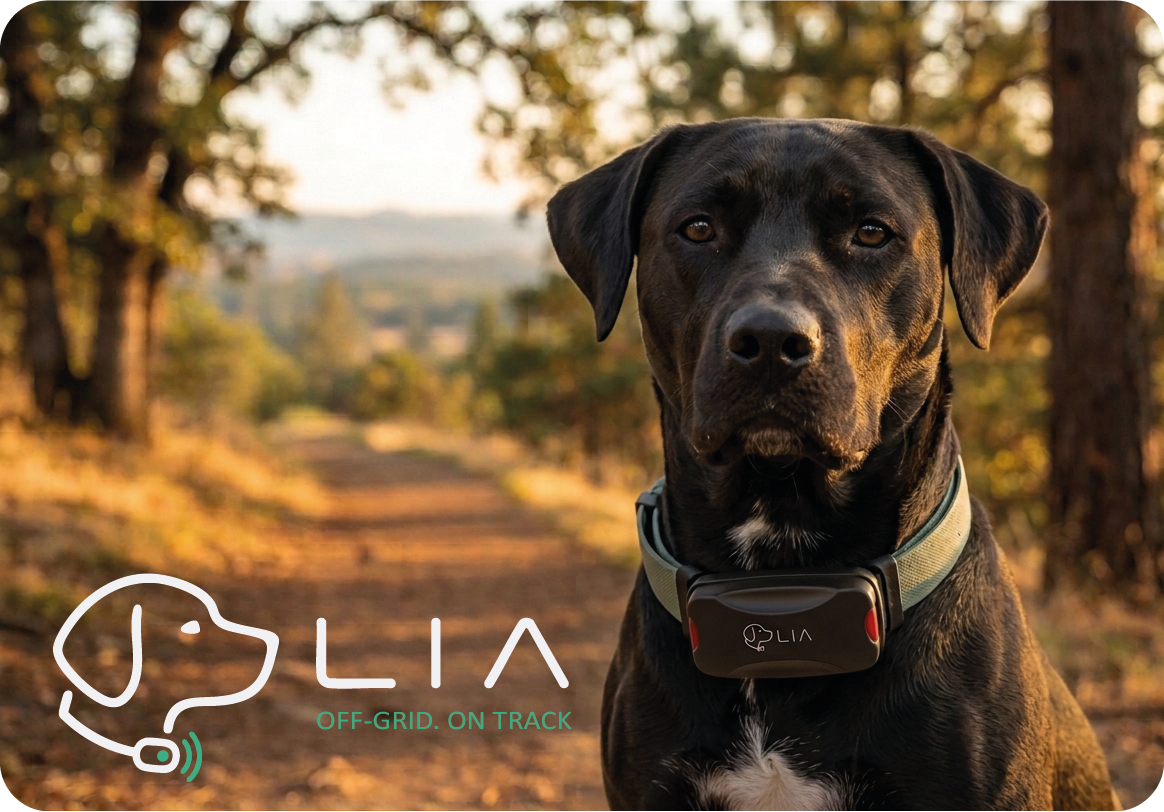
- Long-range LoRa communication over the open Meshtastic protocol
- GPS/GNSS location tracking, sent only as a direct message to a predefined target node — not visible to the wider public mesh
- A physical 3-position mode switch: continuous tracking (LED on, position every 30s), a low-power sleep cycle (wake roughly once a minute, get a fix, report it, sleep again), or fully OFF (cuts power to the MCU while still allowing the battery to charge)
- A text-command interface over the mesh: query position/battery on demand, toggle charge/motion notifications, override the status LED — see Meshtastic Configuration
- Deep-sleep, low-power firmware with real hardware wake sources (timer, mode-switch flip, charger plug-in)
- Subscription-free — no cloud backend required
- Fully open hardware: schematics, PCB layout, BOM, and enclosure CAD
- Compact, collar-mountable, waterproof-by-design enclosure — in three variants, see below
Core components
- ESP32-S3-MINI-1 (MCU, Wi-Fi/BLE)
- SX1262 LoRa transceiver
- u-blox SAM-M10Q GNSS module
- MAX17048 battery fuel gauge
Two hardware revisions, one firmware
Both revisions carry the same reworked LSM6DSOXTR 6-axis IMU and run the identical lia_v1 firmware — the only difference is the battery/enclosure:
- V1.0 — 18650 Li-ion cell (3500 mAh) with magnetic pogo charging.
- V1.1 — a 50×37×4 mm pouch cell (1000 mAh) instead, trading capacity for a much more compact enclosure.
Antennas
- Internal FPC LoRa antenna, or alternatively a standard omnidirectional linear 868/915 MHz antenna (e.g. Seeed's LoRa Antenna Kit)
- Ceramic GNSS patch antenna
See Hardware documentation for full details, and Enclosure for the enclosure variants that pair with these boards.
- Meshtastic firmware
- Astro + Starlight + Tailwind CSS for this documentation site (fully static, no backend, no analytics, no cookies)
LIA/
├── website/       Astro + Starlight documentation & marketing site
├── firmware/       Meshtastic-based firmware (board variants, services, drivers, build tooling)
├── hardware/       KiCad project, PCB renders, schematics, BOM, production files
├── enclosure/       Enclosure CAD (gitignored native files), STEP/STL exports, renders — V1.0-Detachable/, V1.0-Fixed/, V1.1-Fixed/
├── mobile/         Companion mobile app (planned)
├── scripts/       Repo maintenance and tooling scripts
├── .github/       CI/CD workflows, issue & PR templates
├── LICENSE
├── CONTRIBUTING.md
├── CODE_OF_CONDUCT.md
└── README.md
Browse the docs: https://jgaguado.github.io/LIA/
Run the website locally:
cd website
npm install
npm run dev
Hardware: open hardware/kicad/LIA.kicad_pro in KiCad 8+.
Enclosure: three versions — enclosure/V1.0-Detachable/, enclosure/V1.0-Fixed/, enclosure/V1.1-Fixed/ — each with its own step//stl/ exports and drawings/; no CAD license required to view or print them. See Enclosure docs for what differs between them.
Firmware: see firmware/README.md and the Getting Started guide.
Contributions are welcome across hardware, firmware, mechanical design, and documentation. See CONTRIBUTING.md for how to get set up, and CODE_OF_CONDUCT.md for community guidelines.
LIA is released under CC BY-NC-SA 4.0 (Attribution-NonCommercial-ShareAlike). Personal, educational, and community use is welcome; commercial use requires permission from the maintainers. See the License page for details.
- Draft project requirements and design goals
- Complete first hardware revision (V1.0) and a second, more compact revision (V1.1)
- Complete first enclosure revisions — V1.0-Detachable, V1.0-Fixed, and V1.1-Fixed
- Manufacture and assemble first batch of boards
- Smoke-test and validate hardware (radio, GPS, charging, battery gauge, IMU)
- Release first firmware — see Development History for the phase-by-phase log
- Release initial documentation
- Field trial: real-world tracking validation over an extended period
- Measured (not estimated) battery runtime numbers
LIA is an experimental open-source project and should not be considered a guaranteed real-time safety tracking solution.