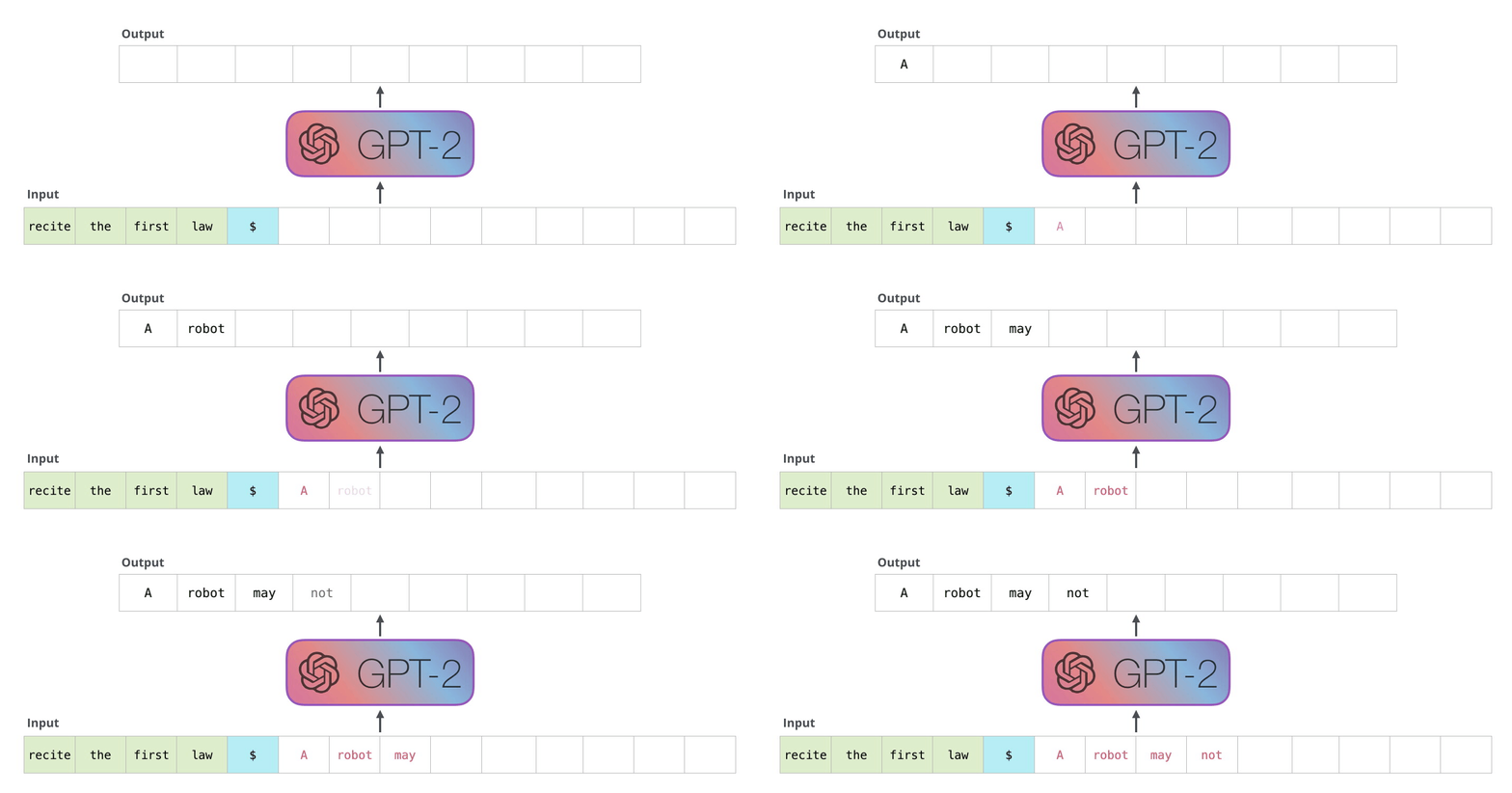
Text generation is where the trained model shows its capabilities. The model generates text one token at a time, using its predictions to extend a prompt into coherent continuation.
- Autoregressive Generation
- Greedy Decoding
- Temperature Sampling
- Top-K Sampling
- Top-P (Nucleus) Sampling
- Step-by-Step Example
- Sampling Strategies Compared
- Code Implementation
- Generation Tips
- References
GPT generates text autoregressively: each new token is predicted based on all previous tokens, then appended to the context.
Prompt: "The cat"
        │
        ▼
┌──────────────────────────────────────────────────────────────────┐
│  Step 1: Forward("The cat") → logits → sample → "sat"           │
│  Context: "The cat sat"                                          │
│                                                                   │
│  Step 2: Forward("The cat sat") → logits → sample → "on"        │
│  Context: "The cat sat on"                                       │
│                                                                   │
│  Step 3: Forward("The cat sat on") → logits → sample → "the"    │
│  Context: "The cat sat on the"                                   │
│                                                                   │
│  Step 4: Forward("The cat sat on the") → logits → sample → "mat"│
│  Context: "The cat sat on the mat"                               │
│                                                                   │
│  ... continue until max_tokens or EOS                            │
└──────────────────────────────────────────────────────────────────┘

Output: "The cat sat on the mat"
The model outputs probability distributions, not single tokens. How we convert these distributions to tokens determines the output's character:
logits → softmax → probabilities → ??? → next token

The ??? is where sampling strategy matters!
Greedy decoding always selects the most probable token.
next_token = argmax(probabilities)Probabilities: [0.05, 0.03, 0.62, 0.20, 0.10]
↑
Tokens: ["a", "an", "the", "that", "this"]
Greedy choice: "the" (index 2, probability 0.62)
| Pros | Cons |
|---|---|
| Deterministic (reproducible) | Repetitive output |
| Fast (no sampling) | Boring, generic text |
| Highest confidence path | Can get stuck in loops |
Greedy decoding often produces repetitive text:
Prompt: "The quick brown"

Greedy output: "The quick brown fox jumps over the lazy dog.
The quick brown fox jumps over the lazy dog.
The quick brown fox jumps over the lazy dog..."
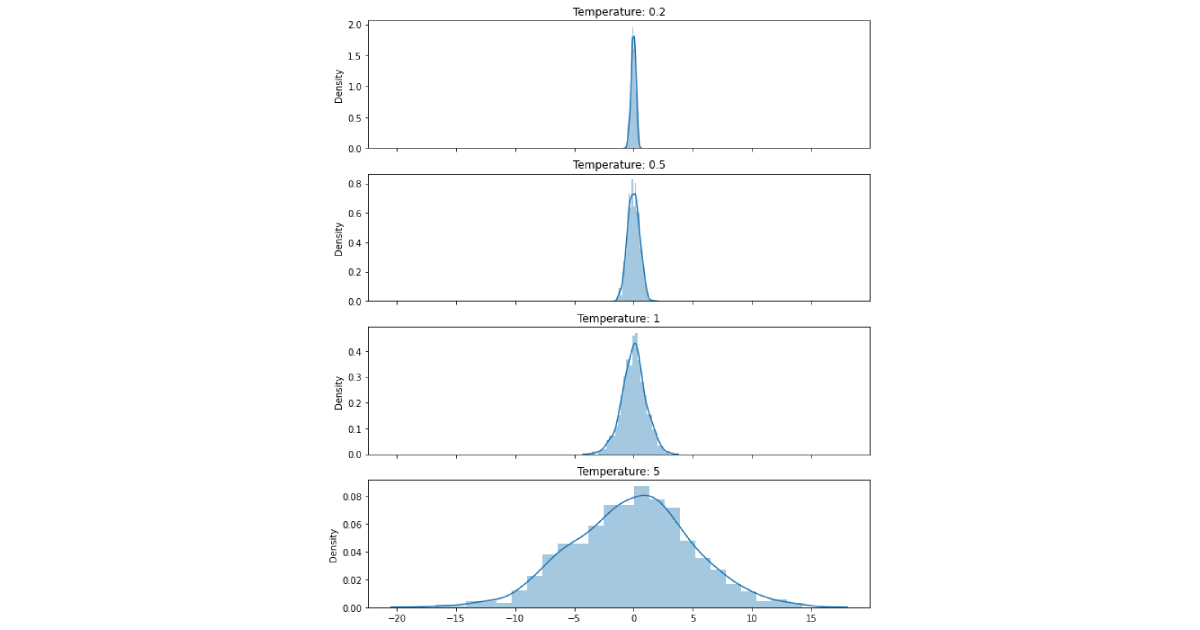
Temperature controls the randomness of sampling by scaling the logits before softmax.
Where:
-
$z_i$ = logit for token$i$ -
$T$ = temperature
| Temperature | Effect | Use Case |
|---|---|---|
| Sharper distribution (more confident) | Factual, focused | |
| Original distribution | Balanced | |
| Flatter distribution (more random) | Creative, diverse | |
| Approaches greedy | Maximum focus | |
| Uniform distribution | Maximum randomness |
Original logits: [2.0, 1.5, 1.0, 0.5, 0.0]

T = 0.5 (cold):          T = 1.0 (normal):        T = 2.0 (hot):
┌─────────────────┐      ┌─────────────────┐      ┌─────────────────┐
│█████████        │0.53  │████████         │0.39  │█████            │0.27
│████             │0.22  │█████            │0.26  │█████            │0.22
│██               │0.13  │████             │0.17  │████             │0.18
│█                │0.08  │██               │0.11  │███              │0.17
│                 │0.05  │█                │0.07  │███              │0.15
└─────────────────┘      └─────────────────┘      └─────────────────┘
Peak probability: 53%         39%                      27%
# Original logits
logits = np.array([2.0, 1.5, 1.0, 0.5, 0.0])

# Temperature = 1.0 (unchanged)
probs_t1 = softmax(logits / 1.0)
# = [0.39, 0.26, 0.17, 0.11, 0.07]

# Temperature = 0.5 (sharper)
probs_t05 = softmax(logits / 0.5)
# = softmax([4.0, 3.0, 2.0, 1.0, 0.0])
# = [0.53, 0.22, 0.13, 0.08, 0.05]

# Temperature = 2.0 (flatter)
probs_t2 = softmax(logits / 2.0)
# = softmax([1.0, 0.75, 0.5, 0.25, 0.0])
# = [0.27, 0.22, 0.18, 0.17, 0.15]
Top-K sampling restricts sampling to only the
# Sort tokens by probability
sorted_probs = argsort(probs)[::-1]  # Descending

# Keep only top K
top_k_probs = sorted_probs[:K]

# Zero out the rest
probs_filtered = zeros_like(probs)
probs_filtered[top_k_probs] = probs[top_k_probs]

# Re-normalize
probs_filtered = probs_filtered / sum(probs_filtered)

# Sample
next_token = sample(probs_filtered)Original probs: [0.35, 0.25, 0.20, 0.12, 0.08]
↑ ↑ ↑
Tokens: [A, B, C, D, E]
Top-3 only: [0.35, 0.25, 0.20, 0.00, 0.00]
Re-normalized: [0.44, 0.31, 0.25, 0.00, 0.00]
↑
Now sample from this
Without top-K, even with temperature adjustment, there's a small chance of sampling very unlikely tokens:
Probabilities: [0.80, 0.10, 0.05, 0.04, 0.01]
                                        ↑
Could sample this garbage token!

With K=3: [0.84, 0.11, 0.05, 0.00, 0.00]
                              ↑
No chance of garbage!
| K value | Result |
|---|---|
| K=1 | Equivalent to greedy |
| K=5-10 | Good balance |
| K=50+ | Almost no filtering |
Top-P (also called nucleus sampling) keeps the smallest set of tokens whose cumulative probability exceeds
# Sort by probability (descending)
sorted_probs = sort(probs)[::-1]

# Find cumulative sum
cumulative = cumsum(sorted_probs)

# Find cutoff (first position where cumsum > P)
cutoff = first_where(cumulative > P)

# Keep only tokens up to cutoff
nucleus = sorted_probs[:cutoff]

# Re-normalize and sampleOriginal probs (sorted): [0.40, 0.30, 0.15, 0.10, 0.05]
Cumulative sum: [0.40, 0.70, 0.85, 0.95, 1.00]
↑
First > 0.9
Nucleus (top 4): [0.40, 0.30, 0.15, 0.10]
Re-normalized: [0.42, 0.32, 0.16, 0.10]
Top-P adapts to the distribution shape:
Scenario 1: Confident prediction
Probs: [0.80, 0.10, 0.05, 0.03, 0.02]
P=0.9 keeps: [0.80, 0.10] (just 2 tokens!)

Scenario 2: Uncertain prediction
Probs: [0.25, 0.20, 0.18, 0.15, 0.12, 0.10]
P=0.9 keeps: [0.25, 0.20, 0.18, 0.15, 0.12] (5 tokens)
With fixed K, you'd either have too few options when confident, or too many when uncertain.
Let's generate "sat on the mat" from prompt "The cat":
Vocabulary (simplified): {"The": 0, "cat": 1, "sat": 2, "on": 3, "the": 4, "mat": 5, ...}
Temperature: 0.8
Top-K: 3
# Forward pass with input [0, 1] ("The cat")
logits = model.forward([[0, 1]])  # Shape: (1, 2, vocab_size)

# Get logits for last position (after "cat")
next_logits = logits[0, -1, :]  # Shape: (vocab_size,)
# = [1.2, 0.5, 3.1, 0.8, 0.3, -0.2, ...]

# Apply temperature (T=0.8)
scaled_logits = next_logits / 0.8
# = [1.5, 0.63, 3.88, 1.0, 0.38, -0.25, ...]

# Softmax to get probabilities
probs = softmax(scaled_logits)
# = [0.08, 0.03, 0.55, 0.05, 0.02, 0.01, ...]

# Top-K filtering (K=3)
# Top 3: "sat"(0.55), "The"(0.08), "on"(0.05)
probs_filtered = [0.08, 0.00, 0.55, 0.05, 0.00, 0.00, ...]
probs_renorm = [0.12, 0.00, 0.81, 0.07, 0.00, 0.00, ...]

# Sample
next_token = sample(probs_renorm) # Likely "sat" (index 2)# Forward pass with [0, 1, 2] ("The cat sat")
logits = model.forward([[0, 1, 2]])
# Get logits for position after "sat"
next_logits = logits[0, -1, :]
# = [0.2, 0.3, 0.1, 2.8, 0.5, -0.1, ...]
# Apply temperature, softmax, top-K...
# Result: "on" sampled (index 3)Step 3: "The cat sat on" → predict "the" (4)
Step 4: "The cat sat on the" → predict "mat" (5)
Input:  "The cat"
Output: "The cat sat on the mat"
Prompt: "Once upon a time there was a"

Greedy (T=0):
"Once upon a time there was a king who lived in a castle.
The king was a good king who lived in a castle. The king..."
(Repetitive, gets stuck)

Temperature 0.5:
"Once upon a time there was a young princess who lived in
the kingdom of Everland. She loved to read books and play
with her cat Whiskers."
(Coherent but predictable)

Temperature 1.0 + Top-K=50:
"Once upon a time there was a peculiar baker named Mortimer
who could communicate with bread. Every morning, the loaves
would whisper secrets of the kingdom."
(Creative, diverse)

Temperature 2.0:
"Once upon a time there was a seventh quantum jellybeans
harmonize the cathedral's purple manifesto concerning
vegetables that telegraph..."
(Too random, loses coherence)
| Goal | Recommended Settings |
|---|---|
| Code generation | T=0.2, greedy or top-K=10 |
| Factual writing | T=0.5-0.7, top-K=50 |
| Creative writing | T=0.8-1.0, top-P=0.95 |
| Brainstorming | T=1.0-1.2, top-P=0.9 |
| Maximum creativity | T=1.5, top-P=0.95 |
From src/model.py:
def generate(
    self,
    prompt_tokens: np.ndarray,
    max_new_tokens: int,
    temperature: float = 1.0,
    top_k: Optional[int] = None,
) -> np.ndarray:
    """
    Generate text autoregressively.

    Starting from the prompt, generate new tokens one at a time by:
    1. Forward pass to get next token probabilities
    2. Sample from the distribution (with temperature)
    3. Append sampled token
    4. Repeat

    Args:
        prompt_tokens: Starting token IDs, shape (batch_size, prompt_length)
        max_new_tokens: Maximum number of new tokens to generate
        temperature: Sampling temperature (higher = more random)
                    0 = greedy (always pick most likely)
                    1 = sample from true distribution
                    >1 = more exploration
        top_k: If set, only sample from top k most likely tokens

    Returns:
        Generated token sequence, shape (batch_size, prompt_length + max_new_tokens)
    """
    # Start with the prompt
    generated = prompt_tokens.copy()

    for _ in range(max_new_tokens):
        # Get the context (limited by max sequence length)
        context_length = min(generated.shape[1], self.config.max_sequence_length)
        context = generated[:, -context_length:]

        # Forward pass to get logits
        logits = self.forward(context)

        # Get logits for the last position
        # Shape: (batch_size, vocab_size)
        next_token_logits = logits[:, -1, :]

        # Apply temperature
        if temperature != 1.0:
            next_token_logits = next_token_logits / temperature

        # Apply top-k filtering
        if top_k is not None:
            # Set all logits outside top-k to -infinity
            top_k_indices = np.argsort(next_token_logits, axis=-1)[:, :-top_k]
            for b in range(next_token_logits.shape[0]):
                next_token_logits[b, top_k_indices[b]] = float("-inf")

        # Convert to probabilities
        probs = softmax(next_token_logits)

        # Sample next token
        next_token = np.zeros((generated.shape[0], 1), dtype=np.int64)
        for b in range(probs.shape[0]):
            next_token[b, 0] = np.random.choice(self.config.vocab_size, p=probs[b])

        # Append to sequence
        generated = np.concatenate([generated, next_token], axis=1)

return generateddef top_p_filtering(logits: np.ndarray, top_p: float = 0.9) -> np.ndarray:
"""
Filter logits using nucleus (top-p) sampling.
Args:
logits: Raw logits, shape (vocab_size,)
top_p: Cumulative probability threshold
Returns:
Filtered logits with low-probability tokens set to -inf
"""
# Sort indices by logit value (descending)
sorted_indices = np.argsort(logits)[::-1]
sorted_logits = logits[sorted_indices]
# Convert to probabilities
probs = softmax(sorted_logits)
# Cumulative probabilities
cumulative_probs = np.cumsum(probs)
# Find where cumulative probability exceeds top_p
cutoff_index = np.searchsorted(cumulative_probs, top_p) + 1
# Create mask for tokens to keep
indices_to_remove = sorted_indices[cutoff_index:]
# Set removed indices to -inf
filtered_logits = logits.copy()
filtered_logits[indices_to_remove] = float('-inf')
return filtered_logitsBad prompt: "Write"
Good prompt: "Write a poem about autumn leaves falling:"
Bad prompt: "The"
Good prompt: "The old wizard carefully opened the ancient tome and read:"
# Factual/Code: Low temperature
output = model.generate(prompt, temperature=0.3)

# Creative writing: Higher temperature
output = model.generate(prompt, temperature=0.9, top_k=50)To reduce repetition, penalize tokens that already appeared:
def apply_repetition_penalty(logits, generated_tokens, penalty=1.2):
    for token in set(generated_tokens):
        logits[token] /= penalty
return logits# Too short: May cut off mid-sentence
model.generate(prompt, max_new_tokens=10) # "The cat sat on the"
# Too long: May degrade quality
model.generate(prompt, max_new_tokens=1000) # Quality drops after a whileRun the demo script:
python run_demo.pyOr experiment directly:
from src.model import GPTModel, GPTConfig
from src.tokenizer import BPETokenizer

# Load trained model and tokenizer
model = GPTModel.load("checkpoints/model_best.npz")
tokenizer = BPETokenizer.load("checkpoints/tokenizer.json")

# Encode prompt
prompt = "ROMEO:"
prompt_tokens = np.array([tokenizer.encode(prompt)])

# Generate with different settings
print("=== Greedy ===")
output = model.generate(prompt_tokens, max_new_tokens=50, temperature=0.001)
print(tokenizer.decode(output[0].tolist()))

print("\n=== Temperature 0.7 ===")
output = model.generate(prompt_tokens, max_new_tokens=50, temperature=0.7)
print(tokenizer.decode(output[0].tolist()))

print("\n=== Temperature 1.0, Top-K 50 ===")
output = model.generate(prompt_tokens, max_new_tokens=50, temperature=1.0, top_k=50)
print(tokenizer.decode(output[0].tolist()))-
Top-K Sampling: Fan, A., et al. (2018). Hierarchical Neural Story Generation
-
Nucleus Sampling: Holtzman, A., et al. (2019). The Curious Case of Neural Text Degeneration
-
Temperature Scaling: Hinton, G., et al. (2015). Distilling the Knowledge in a Neural Network
-
Sampling Strategies Survey: Ippolito, D., et al. (2019). Comparison of Diverse Decoding Methods
-
This Repository: See src/model.py for
GPTModel.generatemethod, run_demo.py for usage examples.
Next Step: Now you can generate text! Continue to 10 - FineTuning.md to learn how to adapt the model to specific tasks with minimal training.