The Solis Modbus Integration for Home Assistant is a streamlined solution to connect your Solis inverter with Home Assistant. This integration was inspired by fboundy's ha_solis_modbus. However, it enhances the native Modbus integration in Home Assistant by consolidating multiple register queries into single calls, eliminating unnecessary overhead.
https://solis-modbus.readthedocs.io/
You will lose access, unless you use a waveshare device. You will still have the option to disable the modbus, when updates are required. #154

To install the Solis Modbus Integration, follow these steps:
- Open your Home Assistant instance.
- Navigate to the "HACS".
- Click the 3 dots menu
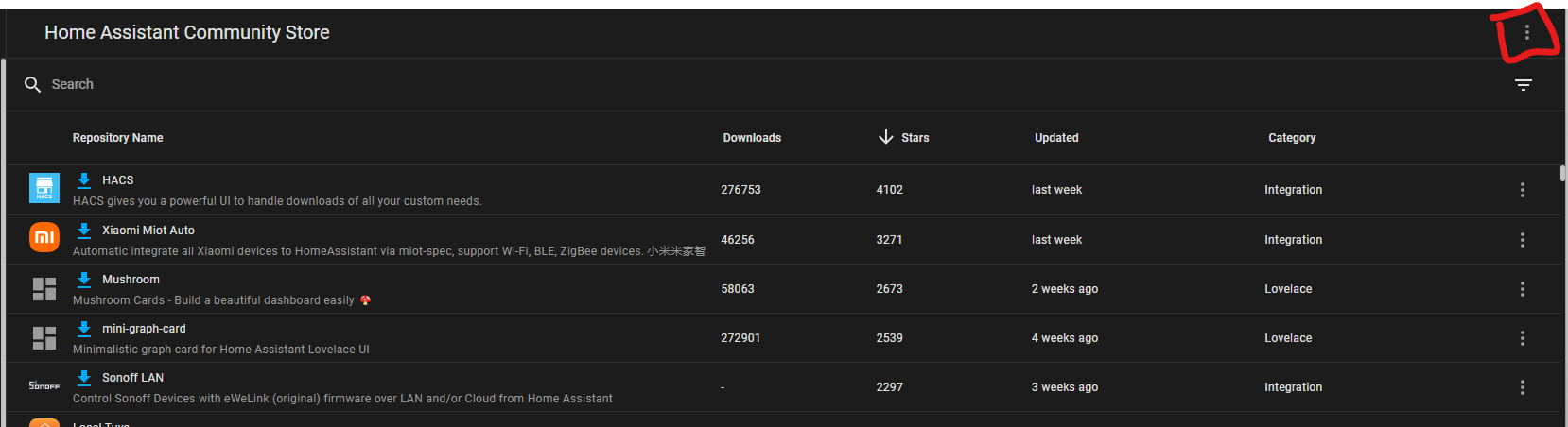
- Click on "Custom Repositories"
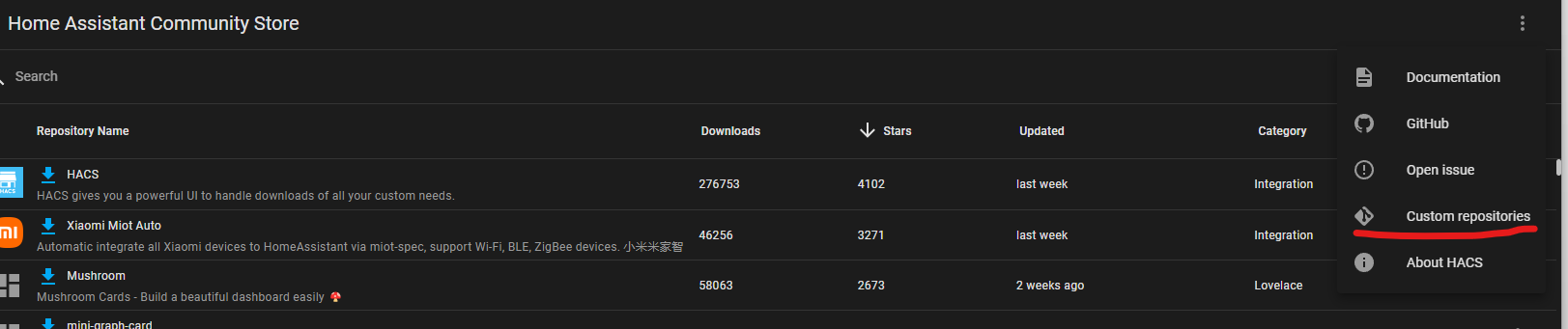
- Fill in the repository "https://github.com/Pho3niX90/solis_modbus", and category "Integration"
- Now search for "Solis Modbus"
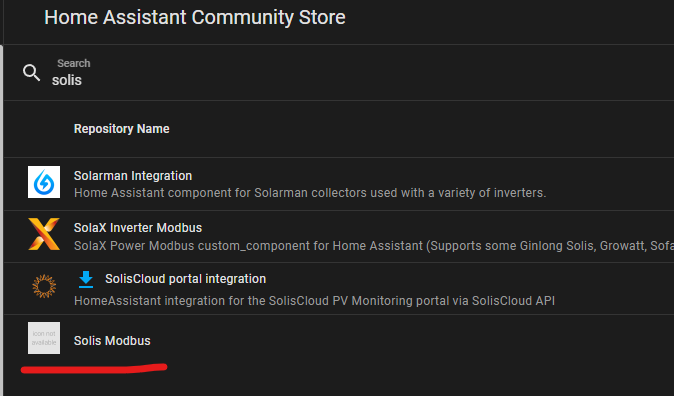
- Click on Download
Whilst the solis inverters do provide total sensors for today, yesterday, month and year. I highly suggest to create a utility meter in HA, as a time difference between HA and Solis might have the values reset before midnight, causing issues in charts.
- Copy the "solis_modbus" folder into your "custom_components" folder
- Navigate to Settings -> Devices & Services
- Click on "+ Add Integration"
- Search for "Solis Modbus"
- Follow the configuration steps:
Connection Type:
- TCP (WiFi Dongle): Use for Data Logging Sticks (DLS) or WiFi dongles. Requires IP and Port (Default 502).
- Serial (RS485): Use for direct USB-RS485 connection. Requires Serial Port path.
Inverter Serial: (Required)
- Enter your inverter's serial number. This is now mandatory for generating unique entity IDs and ensuring configuration stability.
Poll Interval:
- Customize how frequently sensors update. Faster polling provides more real-time data but increases Modbus load.
Fix for #452 — v4.2.0 could create duplicate entities (original Unavailable, new live copy often with a location prefix in the entity_id) when sensor definition dicts changed.
- 4.1.6 → 4.2.3: no duplicates;
entity_ids stay the same; only internalunique_ids are rewritten. - 4.2.0–4.2.2 → 4.2.3: original
entity_ids restored; orphan duplicates removed. Recorder history from the live duplicate is intended to follow via Home Assistant’s entity rename (see caveats in the Migration Guide). - Sensors that only existed from v4.2.0 onward (no pre-duplicate twin) keep their current
entity_id, including any location prefix from the device name at first registration. - If Energy dashboard was pointed at a location-prefixed duplicate, re-select the restored original once.
New features
- Remote Dispatch (dispatch-capable firmware, register 34502 = 0xAA55):
solis_modbus.solis_dispatchcommands real-time goal-seeking control — "hold grid import at 6 kW", "charge battery at 3 kW", PV shutdown, per-dispatch SOC windows — with an inverter-side failsafe (the inverter reverts by itself if HA goes silent).solis_dispatch_scheduleprograms up to six inverter-resident daily periods that keep executing even if Home Assistant dies. Dispatch state is exposed as sensors (44100-44112). - New telemetry: fault/status bitfield words (33116-33123), battery/backup settings mirrors + fast (<1 s) battery current (33200-33217), EPM live state (33246-33250), inverting/rectifying bridge power (33157), remote-dispatch capability flags (34502/34503).
- Instant output clamp (GrugBus-verified 43081 + 43070 gate): watt-level AC output limiting — number entity is registry-disabled by default; enable it to use.
- Storage Mode select (renamed from "Work Mode", issue #413): mode changes now clear all conflicting mode bits — switching Self-Use ↔ Peak Shaving ↔ Feed-in writes exactly the values SolisCloud uses (grid-charge and wakeup bits are preserved). New Reserve / Backup options. The raw register value is exposed as a state attribute for debugging.
- Dual-meter support (issue #425): enable "Second smart meter installed" to poll the Meter 2 block (33300-33337) on "Grid + PV Inverter" installs — per-phase V/A/W, total power, PF, frequency and lifetime import/export counters.
- Direct-meter grid energy for string inverters (issue #410): grid import/export lifetime counters read from the attached meter (registers 3283-3286), for S5-GR3P-style installs without an EPM.
- Read-only mode completed (issue #149): under either reduced poll profile, control entities (numbers/switches/selects/times) are no longer created.
- Poll profiles (issue #457): the "Essential sensors only" toggle is now a Poll profile select — Full, Essential or Extreme. Extreme polls only the live meter/CT and PV groups (plus the one-off identity groups), which is few enough Modbus frames that the fast-interval floor drops from 10s to 2s — for tight control loops such as export limiting against grid voltage rise (issue #451). An opt-in toggle adds the battery/load group (SOC, household load, battery and grid-port power) for battery-aware automations. Existing
essential_onlysettings migrate automatically. Entities outside the chosen profile are not created, rather than created and left unavailable. Extreme mode is an optimisation, not a protection or compliance mechanism: a Home Assistant control loop cannot satisfy G100's requirement that an export limitation scheme hold its limit through component or communications failure. - Diagnostics: download a redacted support dump from the integration's menu.
- Repairs: a repair issue is raised when the datalogger is unreachable for a sustained period, and auto-clears on reconnect.
- New AC-grid-port lifetime energy sensors (registers 33186-33189, protocol Ver3.4).
Fixes (highlights)
- "Solis Modbus Enabled" switch actually enables/disables polling again.
- Leaving a "+ TOU" work mode via the select is possible again.
- Options changes now apply immediately (no restart needed).
- Reduced Modbus retry storms on S2-WL sticks (issues #395/#406) — pymodbus retries lowered; the integration's own watchdog handles recovery.
- Lifetime energy counters decode as unsigned (can no longer wrap negative and corrupt the Energy dashboard).
- Grid-TOU time entities are no longer created for grid/string inverters.
Monthly grid energy (issue #400): the inverter's Modbus map has no monthly grid import/export registers (SolisCloud computes those server-side). Use a utility meter helper instead:
utility_meter:
  monthly_grid_import:
    source: sensor.solis_inverter_today_energy_imported_from_grid
cycle: monthlyAs of version 4.0+, the integration uses the Inverter Serial Number to generate unique IDs for all entities.
- New Installs: Will use Serial Number automatically.
- Existing Installs:
- The integration will attempt to migrate your existing entities (which might use Host ID or the deprecated "Identification" string) to the new Serial Number format automatically on startup.
- If your configuration is missing the Serial Number, migration will be deferred, and a persistent notification will ask you to Reconfigure the integration to add it.
- No history is lost during this migration.
See also v4.2.3 above and the full Migration Guide for the #452 duplicate-entity fix.
Deprecated Settings:
- Identification: This field has been removed from the setup form. If you previously used it, the integration will still read it internally to migrate your old entities, but it is no longer user-configurable.
Connection Type: S2 is the default option, only select waveshare if you are using a waveshare device, and some sensors are higher than normal, see here https://solis-modbus.readthedocs.io/en/latest/sensors.html#waveshare
Get the card here : https://github.com/Pho3niX90/jk-bms-card


type: custom:sunsynk-power-flow-card
view_layout:
  grid-area: flow
cardstyle: lite
large_font: true
show_solar: true
panel_mode: true
card_height: 415px
inverter:
  model: solis
  modern: false
  colour: '#959595'
  autarky: 'no'
solar:
  mppts: 2
  show_daily: false
  colour: '#F4C430'
  animation_speed: 9
  max_power: 9600
  pv1_name: West
  pv2_name: North
battery:
  energy: 14280
  shutdown_soc: 20
  show_daily: true
  colour: pink
  animation_speed: 6
  max_power: 6000
load:
  show_aux: false
  show_daily: true
  animation_speed: 8
  max_power: 6000
  additional_loads: 2
  load2_name: Geyser
  load2_icon: mdi:heating-coil
  load1_name: Pool
  load1_icon: mdi:pool
grid:
  show_daily_buy: true
  no_grid_colour: red
  animation_speed: 8
  max_power: 6000
  invert_grid: true
entities:
  dc_transformer_temp_90: sensor.solis_temperature
  day_battery_charge_70: sensor.solis_today_battery_charge_energy
  day_battery_discharge_71: sensor.solis_today_battery_discharge_energy
  day_load_energy_84: sensor.solis_today_energy_consumption
  day_grid_import_76: sensor.solis_today_energy_imported_from_grid
  day_grid_export_77: sensor.solis_today_energy_fed_into_grid
  day_pv_energy_108: sensor.solis_pv_today_energy_generation
  inverter_voltage_154: sensor.solis_a_phase_voltage
  load_frequency_192: sensor.solis_grid_frequency
  inverter_current_164: sensor.solis_a_phase_current
  inverter_power_175: sensor.solis_backup_load_power
  grid_power_169: sensor.solis_ac_grid_port_power
  battery_voltage_183: sensor.solis_battery_voltage
  battery_soc_184: sensor.solis_battery_soc
  battery_power_190: sensor.solis_battery_power
  battery_current_191: sensor.solis_battery_current
  essential_power: sensor.solis_backup_load_power
  grid_ct_power_172: sensor.solis_meter_total_active_power
  pv1_voltage_109: sensor.solis_dc_voltage_1
  pv1_current_110: sensor.solis_dc_current_1
  pv1_power_186: sensor.solis_dc_power_1
  pv2_power_187: sensor.solis_dc_power_2
  pv_total: sensor.solis_total_dc_output
  pv2_voltage_111: sensor.solis_dc_voltage_2
  pv2_current_112: sensor.solis_dc_voltage_2
  grid_voltage: sensor.solis_a_phase_voltage
  battery_current_direction: sensor.solis_battery_current_direction
  inverter_status_59: sensor.solis_current_status
  remaining_solar: sensor.solcast_pv_forecast_forecast_remaining_today
type: vertical-stack
cards:
  - type: horizontal-stack
    cards:
      - type: entities
        entities:
          - entity: number.solis_time_charging_charge_current
            name: Charge Current
        state_color: true
  - type: horizontal-stack
    cards:
      - type: entities
        entities:
          - entity: number.solis_time_charging_discharge_current
            name: Discharge Current
        state_color: true
  - type: entities
    entities:
      - entity: switch.solis_time_of_use_mode
        type: custom:multiple-entity-row
        name: Charge Slot 1
        toggle: true
        state_header: TOU
        state_color: true
        icon: mdi:timer
        entities:
          - entity: time.solis_time_charging_charge_start_slot_1
            name: Charge From
          - entity: time.solis_time_charging_charge_end_slot_1
            name: Charge To
      - entity: switch.solis_time_of_use_mode
        type: custom:multiple-entity-row
        name: Discharge Slot 1
        toggle: true
        state_header: TOU
        state_color: true
        icon: mdi:timer
        entities:
          - entity: time.solis_time_charging_discharge_start_slot_1
            name: Charge From
          - entity: time.solis_time_charging_discharge_end_slot_1
            name: Charge To
      - entity: switch.solis_time_of_use_mode
        type: custom:multiple-entity-row
        name: Charge Slot 2
        toggle: true
        state_header: TOU
        state_color: true
        icon: mdi:timer
        entities:
          - entity: time.solis_time_charging_charge_start_slot_2
            name: Charge From
          - entity: time.solis_time_charging_charge_end_slot_2
            name: Charge To
      - entity: switch.solis_time_of_use_mode
        type: custom:multiple-entity-row
        name: Discharge Slot 2
        toggle: true
        state_header: TOU
        state_color: true
        icon: mdi:timer
        entities:
          - entity: time.solis_time_charging_discharge_start_slot_2
            name: Charge From
          - entity: time.solis_time_charging_discharge_end_slot_2
            name: Charge To
      - entity: switch.solis_time_of_use_mode
        type: custom:multiple-entity-row
        name: Charge Slot 3
        toggle: true
        state_header: TOU
        state_color: true
        icon: mdi:timer
        entities:
          - entity: time.solis_time_charging_charge_start_slot_3
            name: Charge From
          - entity: time.solis_time_charging_charge_end_slot_3
            name: Charge To
      - entity: switch.solis_time_of_use_mode
        type: custom:multiple-entity-row
        name: Discharge Slot 3
        toggle: true
        state_header: TOU
        state_color: true
        icon: mdi:timer
        entities:
          - entity: time.solis_time_charging_discharge_start_slot_3
            name: Charge From
          - entity: time.solis_time_charging_discharge_end_slot_3
            name: Charge To
    state_color: true
view_layout:
  grid-area: a
Card inspiration from https://github.com/slipx06/Sunsynk-Home-Assistant-Dash
Inverters Tested Solis and equivalent Axitec, Zonneplan inverters
- S6-EH3P
-
- S6-EH3P20K-H (#93)
-
- S6-EH3P15K-H
-
- S6-EH3P(12-20)K-H
-
- S6-EH1P6K-L-PRO
-
- S6-EH1P6K-L-PLUS
-
- S6-EH3P10K-H-ZP (#191)
-
- S6-EH3P10K-H-EU (#202)
- S6-GR1P
-
- S6-GR1P4K (#84)
- S5-EH1
-
- S5-EH1(3-6)K-L (#89)
-
- S5-EH1P5K-L (#94)
-
- S5-EH1P6K-L (#94 (comment))
- S5-GC
-
- S5-GC30K (#173)
-
- S5-GC60K (#180 (comment))
- RAI-*
-
- RAI-3K-48ES-5G (#174)
- RHI-*
-
- RHI-3K-48ES-5G (#97 (comment))
- 3P(3-20)K-4G
-
- 3P6K-4G (#210)
- 1P(2.5-6)K-4G
Wifi Dongles Tested
- S2_WL_ST
- Waveshare
Several Solis dataloggers (S5-WiFi-ST, and reports on S2-WL-ST too) have stopped serving Modbus TCP after a firmware/OTA update. SolisCloud keeps working, so the inverter looks perfectly healthy while Home Assistant can no longer reach it.
Check it from any PC on the same LAN — no Home Assistant involved:
Test-NetConnection 192.168.1.50 -Port 502nc -vz 192.168.1.50 502If ping succeeds but the TCP test fails, the port is closed on the device and no integration setting will fix it — nothing can reopen a port the logger has shut. Port 80 (the logger's own web UI) is usually dead too, which is a good confirmation.
Known workarounds:
- Raise it with Solis support — the more reports the better. Note that the S2-WL-ST product page does advertise Modbus TCP support, which gives you something to point at.
- Use an RS485-to-TCP bridge on the inverter's RS485 port instead of the logger's WiFi stick — an Elfin EW11 and a Waveshare RS485-to-Ethernet have both been confirmed working by users who hit this. The integration then works normally.
- A direct USB RS485 adapter with the serial connection type also bypasses the logger.
See issue #432 for the thread.
If a sensor's entity ID changes (e.g., during migration) and you lose its history, you can manually restore it using Home Assistant's statistics tool:
- Navigate to Developer Tools -> Statistics.
- Search for the sensor name (e.g., "Today Battery Charge Energy").
- You will likely see two entries:
- The current sensor (new ID, working).
- The historic sensor (old ID, typically "Status: Recalculate", missing state, or similar issue). Note down it's ID
- Click on the current sensor, click the gear icon, and now rename the "Entity ID" to the old one
Alternatively, this integration makes it much easier https://github.com/mayerwin/HA-Merge-Sensor-History
If the reconfiguration flow does not ask for your Serial Number, please delete the device and re-add it as a new device.
- Tip: Rename the new device to match your old device's name and select "Recreate Entity IDs" during setup. This will ensure your history and dashboards remain functional. as mentioned here Comment by 0rangutan