
Date: June 23, 2024
View Question

You are given an integer array A of size N, where every element is distinct and represents the x-coordinate of a friend's house.
For example:
A = [1, 3, 8]
means there are friends living at:
- x = 1
- x = 3
- x = 8
The array is guaranteed to be sorted in ascending order.
Each friend's house has a maximum capacity of N - 1 people.
Every friend wants to host a gathering and invite exactly N - 2 friends.
To minimize overall travel, the host always invites the N - 2 closest friends, so that the total distance traveled by all invited friends is as small as possible.
For every friend, return the minimum total distance traveled by the invited guests.
input1: IntegerNinput2: Integer arrayA
Return an integer array where the i-th value represents the minimum total distance traveled when the i-th friend is the host.
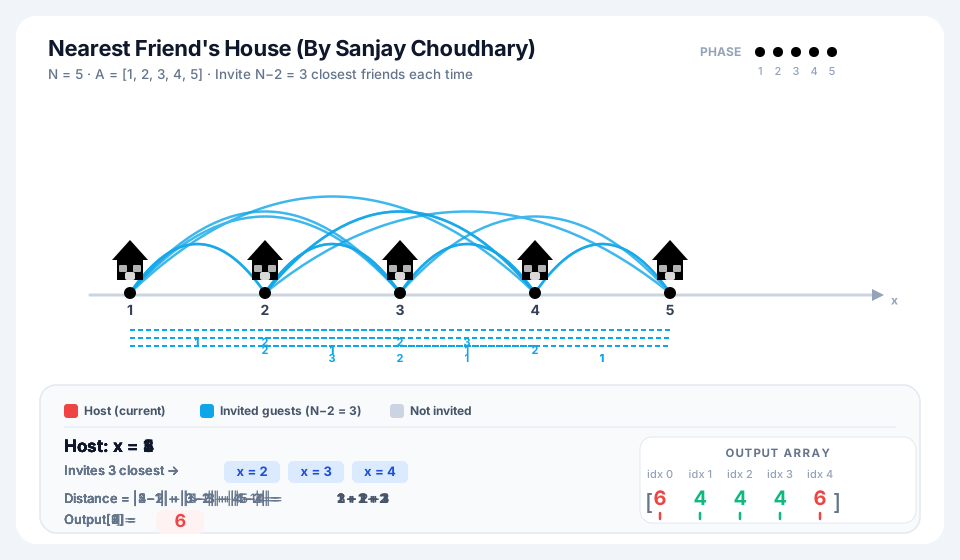
N = 5
A = [1, 2, 3, 4, 5]
[6, 4, 4, 4, 6]
Host = 1
Invites:
- 2
- 3
- 4
Distance:
(2-1) + (3-1) + (4-1) = 6
Host = 2
Invites:
- 1
- 3
- 4
Distance:
(2-1) + (3-2) + (4-2) = 4
Host = 3
Invites:
- 1
- 2
- 4
Distance:
(3-1) + (3-2) + (4-3) = 4
Host = 4
Invites:
- 2
- 3
- 5
Distance:
(4-2) + (4-3) + (5-4) = 4
Host = 5
Invites:
- 2
- 3
- 4
Distance:
(5-2) + (5-3) + (5-4) = 6
Tip
To better understand how the algorithm chooses the closest N-2 friends and computes the minimum total distance, try the interactive visualization below.
| Platform | Problem | Why it is Similar |
|---|---|---|
| LeetCode | 658. Find K Closest Elements | Closest element selection around a target |
| LeetCode | 2602. Minimum Operations to Make All Array Elements Equal | Prefix sums and distance calculations |
| LeetCode | 296. Best Meeting Point | Distance minimization |
| LeetCode | 849. Maximize Distance to Closest Person | Distance-based reasoning |
| HackerRank | Closest Numbers | Adjacent distance computation |
| HackerRank | Sherlock and MiniMax | Distance optimization on a number line |
View Question

Lucy has an integer array A of size N.
All elements are distinct.
She may perform the following operation any number of times:
Choose two elements x and y such that
LCM(x, y) × HCF(x, y)
is also present in the array.
Return the maximum number of valid ordered pairs (x, y).
Note
Using the identity:
LCM(x, y) × HCF(x, y) = x × y
the problem simplifies to:
Find all ordered pairs (x, y) such that
x × y
exists in the array.
Also note:
(x, y) ≠ (y, x)
Both are counted separately.
input1: IntegerNinput2: Integer arrayA
Return the maximum number of valid ordered pairs.
N = 5
A = [1, 2, 3, 4, 5]
10
Valid ordered pairs are:
(1,1)
(1,2)
(2,1)
(1,3)
(3,1)
(1,4)
(4,1)
(1,5)
(5,1)
(2,2)
Hence,
Answer = 10
| Platform | Problem | Why it is Similar |
|---|---|---|
| LeetCode | 1726. Tuple with Same Product | Product hashing (closest match) |
| LeetCode | 2183. Count Array Pairs Divisible by K | Pair counting using number theory |
| LeetCode | 2001. Number of Pairs of Interchangeable Rectangles | Hash map based pair counting |
| LeetCode | 1497. Check If Array Pairs Are Divisible by k | Pair formation using mathematical properties |
| HackerRank | Pairs | Efficient pair counting |
| HackerRank | Count Triplets | Hashing and frequency optimization |
Important
For the complete 2024 Machine Learning Questions and additional 2024 Hands-On Programming Questions, refer to:
Amazon ML Summer School 2024 ML Assessment PDF