Control, inspect, test, and capture real terminal applications for agents and TUI review.


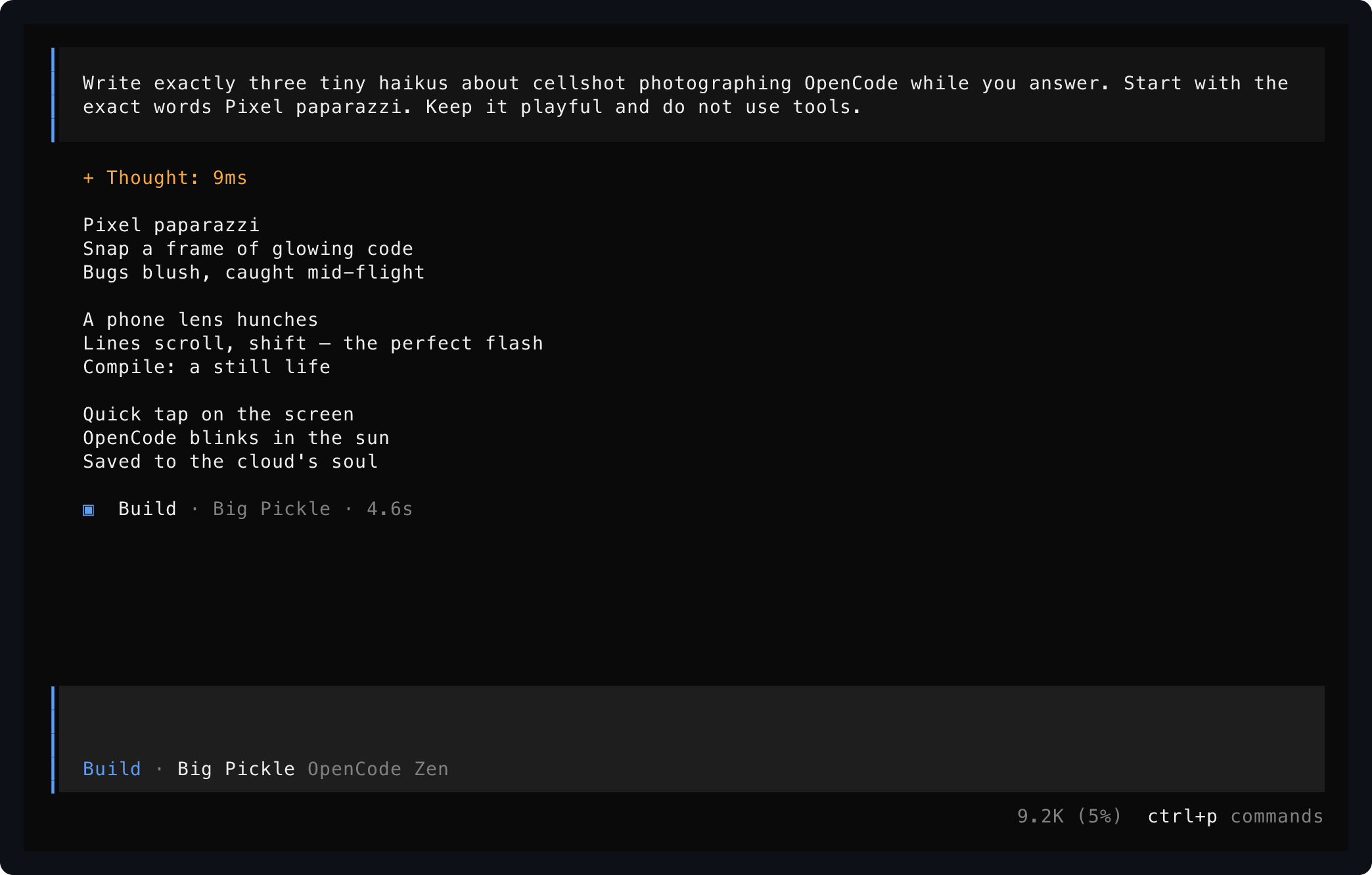
Saved from one live OpenCode session using start, send, and save.
Source builds require Rust 1.93 or newer, Zig 0.15.2, Git, and network access while the pinned
Ghostty terminal core is built. Video export also requires ffmpeg.
cargo install --locked terminal-control
termctrl --help
Or install the current repository head:
cargo install --locked --git https://github.com/anomalyco/terminal-control terminal-controlTerminal Control is built for agents first. Install the skill so your coding agent knows the workflow:
npx skills add anomalyco/terminal-control --skill terminal-controlOr expose sessions as structured MCP tools instead of shell commands (stdio server):
termctrl mcpMCP screen reads and interactions return the current frame immediately. Agents can opt into
quiet-output settling with settleMs and deadlineMs when a specific transition requires it.
list_sessions returns running sessions by default and accepts state, command, and cwd
filters for bounded server-side discovery.
| MCP task | Tools |
|---|---|
| Discover | list_sessions, get_session_status |
| Observe and drive | get_screen, save_screen, send_input, send_mouse, interact, resize_session |
| End processes | stop_session |
Then ask for terminal work in ordinary language:
Use terminal-control to open my TUI, press through the setup flow, and save a screenshot of the final screen.
Record yourself using the terminal app, mark the important moments, and export a short MP4 demo.
The skill teaches the safe workflow: start named sessions, wait for visible text, send exact input, inspect screens, save artifacts, record timelines, and stop sessions when finished.
show runs a program in a PTY and prints its settled visible screen to stdout. No files are created.
termctrl show --cols 100 --rows 32 -- my-terminal-appWait for the app to mount and interact before reading:
termctrl show --cols 100 --rows 32 --wait-for "Commands" \
  -s ctrl-p text:model enter -- my-terminal-app
Other stdout representations are explicit:
termctrl show --format json -- my-terminal-app
termctrl show --format svg -- my-terminal-appsave writes only the artifact formats you request:
termctrl save --format png --out captures/home.png -- my-terminal-app
termctrl save --format png --format txt --out captures/model -- my-terminal-app
The second command writes captures/model.png and captures/model.txt. Raw ANSI artifacts can contain sensitive terminal data and require explicit --format ansi.
Use a named session when several interactions target the same running application:
termctrl start demo --host opentui --cols 112 --rows 34 -- my-terminal-app
termctrl wait demo "Ready"
termctrl send demo text:help enter
termctrl show demo
termctrl show demo --format semantic
termctrl save demo --format png --out captures/help.png
termctrl stop demosendacceptstext:<value>, named keys (enter,escape, arrows,tab,shift-tab,backspace,delete,home,end,page-up,page-down), andctrl-athroughctrl-z. Pipe exact bytes with--stdin.mouse demo move 12 4hovers at zero-based column 12, row 4;mouse demo click 12 4clicks. Usedown,move, thenupto drag;--button right,--shift,--alt, and--ctrlare supported. The app must enable mouse reporting (hover needs any-event tracking).show NAMEreads immediately;waitreturns as soon as text is visible. Its five-second default is a maximum, not a fixed delay. Use it instead of sleeping.statusreports running/exited state, command, cwd, viewport, and recording path.listshows running sessions; use--state,--command, or--cwdto filter discovery, and--allto include every retained or unavailable entry.prune --dry-runpreviews retained exited sessions and stale sockets;pruneremoves them without deleting recording artifacts.resize demo --cols 132 --rows 38tests responsive layouts.restart demorelaunches with the stored command, cwd, viewport, and recording settings.- An exited session keeps its final screen for
showuntil stopped.
For fast automation, batch a known send → wait → show transition in one shell call, or use
MCP interact with waitFor. Leave typing unpaced unless the demo needs it; reserve PNG saves
for visual checks and export video after the interactions.
OpenTUI applications such as OpenCode need the opt-in host handshake:
termctrl start demo --host opentui --cols 112 --rows 34 -- opencode
termctrl wait demo "/connect"
For normal-screen tools and log-like processes, read retained scrollback with logs:
termctrl logs demo
termctrl logs demo --ansi > captures/demo-output.ansi
Full-screen alternate-screen TUIs do not produce useful logs; read their visible screen with show.
Terminal Control gives applications launched with --host opentui a private
TERMCTRL_SEMANTIC_SOCKET. Cooperating applications can provide structured UI semantics without
changing terminal output:
termctrl start demo --host opentui -- my-tui
termctrl show demo --format semantic
Applications without a semantic provider return an empty snapshot. See docs/semantic-protocol.md for the protocol and the OpenTUI adapter.
run keeps the application visible and interactive in your current terminal pane while agents control the same PTY through the named session commands:
termctrl run -- nvim
termctrl run editor --cwd ~/src/project -- nvim
Without NAME, the session name is the executable basename (nvim above); a name collision is an error, never a suffixed name. No tmux or multiplexer involved.
Record a timeline, mark moments while it runs, then export an edited MP4:
termctrl start demo --record captures/demo.termctrl --host opentui -- opencode
termctrl wait demo "Ask anything"
termctrl mark demo before-prompt
termctrl send demo --pace-ms 35 'text:Write a terminal haiku. End with DONE.' enter
termctrl wait demo "DONE" --timeout 60000
termctrl mark demo after-answer
termctrl stop demo

termctrl markers captures/demo.termctrl
termctrl show --recording captures/demo.termctrl --at-marker after-answer
termctrl video captures/demo.termctrl --edit captures/demo.json --footer --out captures/demo.mp4
An edit plan selects marker ranges with per-clip speed, captions, and optional end holds:
{
  "clips": [
    {
      "from": "before-prompt",
      "to": "after-answer",
      "speed": 4,
      "caption": "The agent answers inside the live terminal UI"
    }
  ]
}
Without --edit, export preserves recorded timing. --footer renders captions, timecode, and branding in a bottom bar. --tail-ms 0 removes the default one-second final hold. Keep speeds low enough for text to stay readable.
Mouse visualization is opt-in at export, independent of the terminal's text cursor:
termctrl start pointer-demo --record captures/pointer.termctrl -- my-mouse-enabled-tui
termctrl wait pointer-demo "Ready"
termctrl mouse pointer-demo move 12 4
termctrl mouse pointer-demo click 12 4
termctrl stop pointer-demo
termctrl video captures/pointer.termctrl --pointer-overlay --out captures/pointer.mp4
The overlay uses a neutral outlined arrow, smooth 220ms travel arriving at the input instant,
subtle press compression, and short fades. Pointer exports default to 60 fps (otherwise 20);
--fps overrides either default. --pointer-reduced-motion keeps fades without travel or scaling.
Edits preserve alignment through cuts, speed changes, holds, and resizes. No animation changes
the real input or adds delays. Only typed mouse operations provide pointer evidence; raw bytes
and human input forwarded by run are not inferred. show and save remain unadorned terminal state.
New recordings use format v2; current readers also accept v1. Older binaries must be updated to read v2 recordings. Restart older named sessions before using the new mouse command.
Recordings are JSON Lines files containing terminal output and typed input; they can include prompts or secrets. Treat them as sensitive.
Capture piped command output, or render an existing ANSI/VT stream without launching a process:
termctrl save --pipe --format png --cols 100 --rows 16 --out captures/log -- my-command
printf '\033[44;97m terminal output \033[0m\n' | termctrl show --input -
One-off show and save own disposable processes: after the read or save, the launched process tree is terminated. Use start for long-running applications.
@kitlangton/terminal-control on npm wraps the driver as typed test sessions with bundled native binaries — no Rust toolchain needed:
bun add -d @kitlangton/terminal-control vitestimport { TerminalControl } from "@kitlangton/terminal-control"
await using terminal = await TerminalControl.make()
await using session = await terminal.launch({ command: ["my-tui"] })
await session.screen.waitForText("Ready")
await session.keyboard.press("Enter")
expect(await session.screen.text()).toMatchSnapshot()See docs/typescript-client.md for artifacts, recordings, Vitest matchers, and configuration.
- docs/rust-library.md — embed the shot engine and sessions in Rust, plus versioned JSON schemas.
- docs/driver-protocol.md — the
termctrl driverJSON Lines protocol for external tooling. - docs/semantic-protocol.md — the application semantic socket handshake and snapshot contract.
- docs/typescript-client.md — the npm test client in full.
- docs/releasing.md — aligned crates.io, npm, and GitHub release process.
- Persistent sessions use owner-only local Unix sockets and are supported on macOS and Linux.
--host opentuianswers startup probes needed by current OpenTUI applications.- Terminal state and reflow use the statically linked Ghostty terminal core; renderers export PNG, SVG, JSON, text, and raw ANSI artifacts.
- Run
termctrl <command> --helpfor dimensions, timing, color, rendering, and output options.