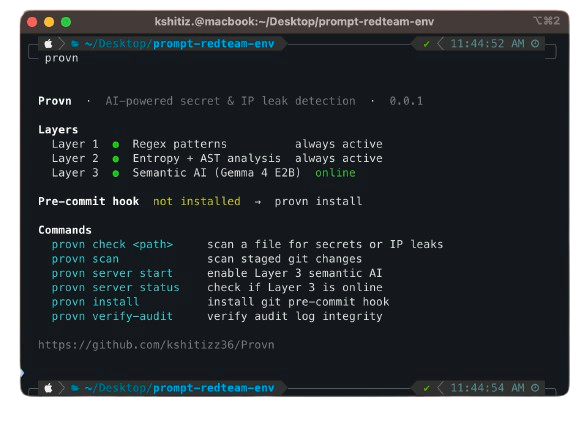
AI powered secret and IP leak detection that runs before code leaves your machine.
npm install -g @ashvinctrl/provn
brew install ashvinctrl/tap/provn
Provn is a local first pre commit scanner that blocks secrets, API keys, tokens, private keys, and proprietary snippets before they land in git. Layer 1 and Layer 2 work immediately. Layer 3 AI is optional and installs separately.
npm install -g @ashvinctrl/provnbrew install ashvinctrl/tap/provncurl -fsSL https://raw.githubusercontent.com/ashvinctrl/Provn/main/install.sh | bashcd your-repo
provn install
git add .
git commit -m "first protected commit"Layer 3 is optional. Layers 1 and 2 do all the work above without it.
provn model install     # downloads NVIDIA Nemotron 3 Nano 4B (Q4_K_M, 2.8 GB)
provn server start      # runs it on 127.0.0.1:8080
provn server status
No Hugging Face account, no hf CLI, no login. provn model list shows what
is available and what is already on disk. You do need llama-server
(llama.cpp) on PATH — brew install llama.cpp.
1. Install the pre commit hook in your repo
cd your-repo
provn install
2. Commit as normal. Provn runs automatically.
git add .
git commit -m "add feature"
#   ✓  clean  12ms
3. Watch it catch a real secret
echo 'api_key = "<paste-real-api-key-here>"' >> config.py
git add config.py && git commit -m "oops"
#
# Example output when the staged file contains a live key:
#   ✗  blocked  [T1]
#   Matched pattern: generic_api_key  via regex
#   config.py:1
#
#   - api_key = "<paste-real-api-key-here>"
#   + PROVN_REDACTED_API_KEY_1
#
# Accept redaction? [y/N]provn Status dashboard with layers, hook, and server state
provn check <path> Scan a file OR directory tree for secrets or IP leaks
provn check --format sarif <p> SARIF 2.1.0 output for GitHub Code Scanning
provn check --json <path> Machine readable JSON for CI
provn check --fail-on T0,T1 Fail only on the listed tiers (default: any finding)
provn scan Scan staged git changes (pre-commit hook mode)
provn scan --fail-on T0,T1 Exit non-zero on listed tiers, never prompt (CI-safe)
provn scan --auto-redact Redact blocked findings without prompting
provn scan --json Emit findings as JSON lines
provn check-range <old> <new> Scan a commit range (pre-push hook mode)
provn check-range --format sarif SARIF for a diff, for PR-scoped code scanning
provn scan-history Scan all of git history for secrets ever committed
provn baseline [path] Accept current findings so only new ones are flagged
provn model list Show available Layer 3 models and what is installed
provn model install [id] Download a Layer 3 model into ~/.provn/models
provn server start|stop|status Manage the Layer 3 AI model server
provn install [--pre-push] Install the pre-commit hook (and optional push gate)
provn verify-audit Verify the HMAC audit log chain
--fail-on means different things by design: on check / check-range it
narrows failure to the listed tiers (without it, any finding fails), while on
scan it additionally suppresses the interactive redaction prompt so a hook is
safe to run headless.
A repo with historical secrets or noisy fixtures shouldn't bury you in findings on day one:
provn baseline .          # accept everything currently present → .provn/baseline.json
git add .provn/baseline.json && git commit -m "provn baseline"
From then on only new secrets are flagged. The baseline stores one-way
hashes — never the secret itself — and rotating or changing any secret yields a
new fingerprint that is reported again, so a baseline can never hide a new
leak. Run provn scan-history to audit what's already buried in past commits.
provn install --pre-push   # pre-commit (fast feedback) + pre-push (full outgoing scan)
provn check .              # scan the entire working tree on demand (respects .gitignore)
Pre-commit and pre-push hooks are bypassable with git commit --no-verify. The hard gate is CI:
.github/workflows/provn-enforce.yml scans every push and PR and
blocks merge on T0/T1 findings, and provn-sarif.yml uploads results
to GitHub Code Scanning — so a bypassed hook never reaches main.
Provn runs three detection layers in sequence:
| Layer | Method | Latency | Catches |
|---|---|---|---|
| 1a | Regex patterns — 72 built-in rules + NFKC normalization + split-string reassembly | <5ms | AWS/Azure/GCP keys, GitHub/GitLab tokens, Stripe/Square, Slack/Twilio/SendGrid, OpenAI/Anthropic/HF, Terraform/Databricks/Doppler, Postman/Linear/Notion/Atlassian, PlanetScale/Supabase, DB URLs, private keys, mnemonics, object-storage URIs, internal hostnames, confidentiality notices, prompt-secrecy instructions, private data paths, safety-control overrides, training configs |
| 1b | Shannon entropy analysis with per-extension thresholds + allowlist | <5ms | High-entropy strings in assignments, hex-encoded secrets |
| 2 | Tree-sitter AST analysis | <50ms | system_prompt = "...", const apiKey = "...", apiKey := "..." in Python / JS / TS / TSX / Go / Java |
| 3 | Gemma 4 E2B (on-device, optional) | <800ms | Ambiguous IP leaks in the 0.4–0.8 confidence band |
Layer 3 only activates for ambiguous cases. Confident detections from L1 and L2 skip it entirely. The built-in
pattern set lives in provn-cli/patterns.toml and can be overridden at runtime via
layers.regex.patterns_file — no recompile needed.
Detection coverage (measured by provn-cli/tests/adversarial.rs): 7/7 obfuscated-secret cases detected
(base64, hex, comment, multiline, split-string, homoglyph, BIP39 mnemonic); 0 false positives across SHA-256
checksums, UUIDs, bcrypt hashes, base64 PNG headers, and semver strings.
Risk tiers:
| Tier | Action | Examples |
|---|---|---|
| T0 | Hard block | Private keys, DB passwords, cloud credentials |
| T1 | Block + optional redaction | API keys, system prompts, model configs |
| T2 | Warn, allow commit | High-entropy tokens |
| T3 | Log only | Low-signal patterns |
Provn ships as a reusable action, so adopting it is three lines. It downloads the released binary and verifies its published SHA-256 — no Rust toolchain, no build step:
- uses: actions/checkout@v4
  with: { fetch-depth: 0 }   # check-range needs both sides of the diff
- uses: ashvinctrl/Provn@v1
By default it scans only what the push or pull request adds and fails on T0/T1. To scan the whole tree and publish to GitHub Code Scanning:
- uses: ashvinctrl/Provn@v1
  with:
    scan: path
    path: .
    sarif-file: provn.sarif
- uses: github/codeql-action/upload-sarif@v3
  with:
sarif_file: provn.sarif| Input | Default | Meaning |
|---|---|---|
version |
latest |
Release tag to run |
scan |
diff |
diff (push/PR changes) or path (full tree) |
path |
. |
What to scan when scan: path |
fail-on |
T0,T1 |
Tiers that fail the job; empty string reports only |
sarif-file |
— | Write SARIF 2.1.0 here |
config |
— | provn.yml to use |
It sets two outputs, findings and clean.
repos:
  - repo: https://github.com/ashvinctrl/Provn
    rev: v0.3.0
    hooks:
      - id: provn
Install the binary first — the hook runs it rather than building it.
Layer 3 adjudicates the ambiguous 0.4–0.8 confidence band — mostly unmarked proprietary algorithms, which no regex can recognise. It is optional, and off until you configure it.
provn model install     # NVIDIA Nemotron 3 Nano 4B, Q4_K_M, 2.8 GB, open weights
provn server start
provn server status
#   ●  Layer 3 online  ·  127.0.0.1:8080
Then in provn.yml:
layers:
  semantic:
    enabled: true
    model: NVIDIA-Nemotron3-Nano-4B-Q4_K_M.gguf
    endpoint: http://localhost:8080
    timeout_ms: 2000
provn model list shows every model Provn can fetch. Requires llama-server
(llama.cpp) on PATH.
If you already pay for an OpenAI-compatible endpoint, point Layer 3 at it
instead of hosting a model. Any provider speaking /v1/chat/completions works —
NVIDIA NIM, OpenAI, or your own gateway.
layers:
  semantic:
    enabled: true
    endpoint: https://integrate.api.nvidia.com/v1
    api_key_env: NVIDIA_API_KEY      # the variable NAME, never the key itself
    api_model: nvidia/nemotron-3-nano-4b
export NVIDIA_API_KEY=...Two things to be clear about, because they cut against Provn's whole premise:
- This sends code off your machine. Provn prints a warning the first time a scan transmits to a non-loopback host, rather than doing it quietly. Layers 1 and 2 always stay local.
- The key is read from the environment, never from
provn.yml. The config names a variable; it cannot hold a credential.provn.ymlis committed to the repository it protects, and a scanner whose own config file is a place to put secrets would be a bad joke.
provn.yml in your repo root. All fields are optional and have sensible defaults:
mode: enforce          # enforce | warn | shadow

exclude_dirs:
  - node_modules
  - .git
  - dist

layers:
  regex:   { enabled: true }
  entropy: { enabled: true, threshold: 4.5, min_length: 20 }
  ast:
    enabled: true
    sensitive_vars: [system_prompt, api_key, secret, password, token, private_key]
  semantic:
    enabled: false
    model: NVIDIA-Nemotron3-Nano-4B-Q4_K_M.gguf
    endpoint: http://localhost:8080
    timeout_ms: 2000
    fallback: layer1          # layer1 | clean
    ambiguous_low: 0.4
    ambiguous_high: 0.8
    api_key_env:              # env var NAME for a hosted endpoint (see Layer 3)
    api_model:                # model id to request from a hosted endpoint

audit:
  enabled: true
  path: .provn/audit.jsonl   # HMAC-chained append-only log
Inline overrides:
secret = os.getenv("SECRET")  # provn:allow
# provn:skip-file ← at top of file to skip entirelyDetection accuracy is measured by provn bench against two committed corpora.
Reproduce both:
cd provn-cli
cargo run --release -- bench tests/corpus/realistic.jsonl
cargo run --release -- bench tests/corpus/leakbench.jsonl
# or, with the regression gate: ./scripts/run-leakbench.sh
All numbers below are the deterministic layers only (Layer 1+2, semantic model off), measured 2026-08-09.
Realistic corpus (realistic.jsonl
— 94 samples: 48 real-format secrets + 46 secret-adjacent clean snippets). This
is the representative real-world signal:
| Metric | Value |
|---|---|
| Secret recall | 100% (48/48) |
| Precision | 100% |
| False positive rate | 0% (0/46) |
| Engine latency | p50 0.71ms · p95 0.97ms per snippet |
These numbers are on a small representative corpus, not a guarantee of perfect
coverage on every real secret — but the gaps an earlier run surfaced are now
closed: password-only redis://:pass@… URLs, encryption_key-style variable
names, and the your-api-key-here / <YOUR_PASSWORD> placeholder false
positives are all handled and locked by unit tests.
Adversarial corpus (leakbench.jsonl
— 229 samples: 125 leaks + 104 clean). This is the same hard set used to train
the Layer 3 model, so it is deliberately heavy on semantic-IP and obfuscated
cases the offline layers are not expected to catch alone:
| Metric | Value |
|---|---|
| Precision | 98.8% |
| False positive rate | 1.0% (1/104) |
| Secret recall | 67.3% (33/49) — credential leaks |
| IP / prompt recall | 68.4% (52/76) — most IP now caught offline |
IP recall went 18.4% → 30.3% → 68.4% over two rounds of detector work, at an unchanged false positive rate. The first round found proprietary locations (object-storage URIs, internal hostnames). The second finds proprietary content: confidentiality notices, system prompts that instruct the model to conceal its own instructions, private dataset paths, disabled safety controls, internal resource identifiers, and fine-tuning hyperparameters. What still misses is unmarked proprietary algorithms — a scoring function with no comment saying it is confidential looks like ordinary arithmetic to a regex, and stays a Layer 3 (semantic) job.
The regression gate in
provn-cli/tests/leakbench.rs fails CI if recall
drops, the false positive rate climbs, or per-snippet latency regresses by an
order of magnitude on either corpus.
End-to-end pre-commit latency (process start + git diff + scan) is ~30–50ms on a
clean commit — run provn scan in a repo to measure it for your own tree.
# Unit tests
cd provn-cli && cargo test

# Lint
cargo clippy -- -D warnings

# Fine-tune Layer 3 on Modal A10G (requires Modal account)
cd aegis-model && modal run modal_finetune.py

# Export fine-tuned GGUF
modal run modal_finetune.py::main_gguf- Regex patterns inspired by Gitleaks (MIT)
- Layer 3 model: Gemma 4 E2B fine-tuned on LeakBench dataset
MIT License