
What you mind is what you get.
🌐 EN · DE · ES · JA · RU · ZH — English is authoritative; translations may lag.
A local-first recipe for an operator to build an empirical, inspectable preference and decision-support model from their own AI interaction logs. It can help an authorized agent anticipate feedback in recurring situations; it does not reveal a person's mind and must not be used for psychological diagnosis, covert profiling, or high-stakes autonomous decisions.
It works by feedforward: the agent makes an explicitly uncertain feedback prediction, uses it only inside the operator's authorization boundary, and later evaluates it against real feedback. Novel, external, irreversible, or high-impact actions always require confirmation.
Status: 1.1.0-dev — public development release. The deterministic safety and classification
contracts are tested on Windows and Linux; semantic model quality still requires human review.
The agent reads authorized logs, distils what the user explicitly decided, how they phrased it, and whether later feedback offered a weak outcome signal, and turns it into a small set of living, editable documents. These are hypotheses with citations, not facts about an inner mental state.
It is not a chatbot persona and not a heavy framework — it is a method + a handful of scripts
- document templates. The only agent-specific part is the source adapter (where each agent reads its own logs). Everything else is universal.
Run the deterministic preparation/validation pipeline and feedback scorer offline on synthetic data — no LLM, no API key, no network:
git clone https://github.com/ellmos-ai/build-your-users-mind
cd build-your-users-mind
python examples/synthetic-demo/run_demo.py
You'll watch extract → merge → chunk → classify → validate → aggregate → score feedback run on a
fictional user's logs and pre-authored loop fixtures (a planted secret gets redacted), then the hard
validation gate reject a tampered result with a non-zero exit. The fixtures demonstrate mechanics,
not accuracy. Details: examples/synthetic-demo/.
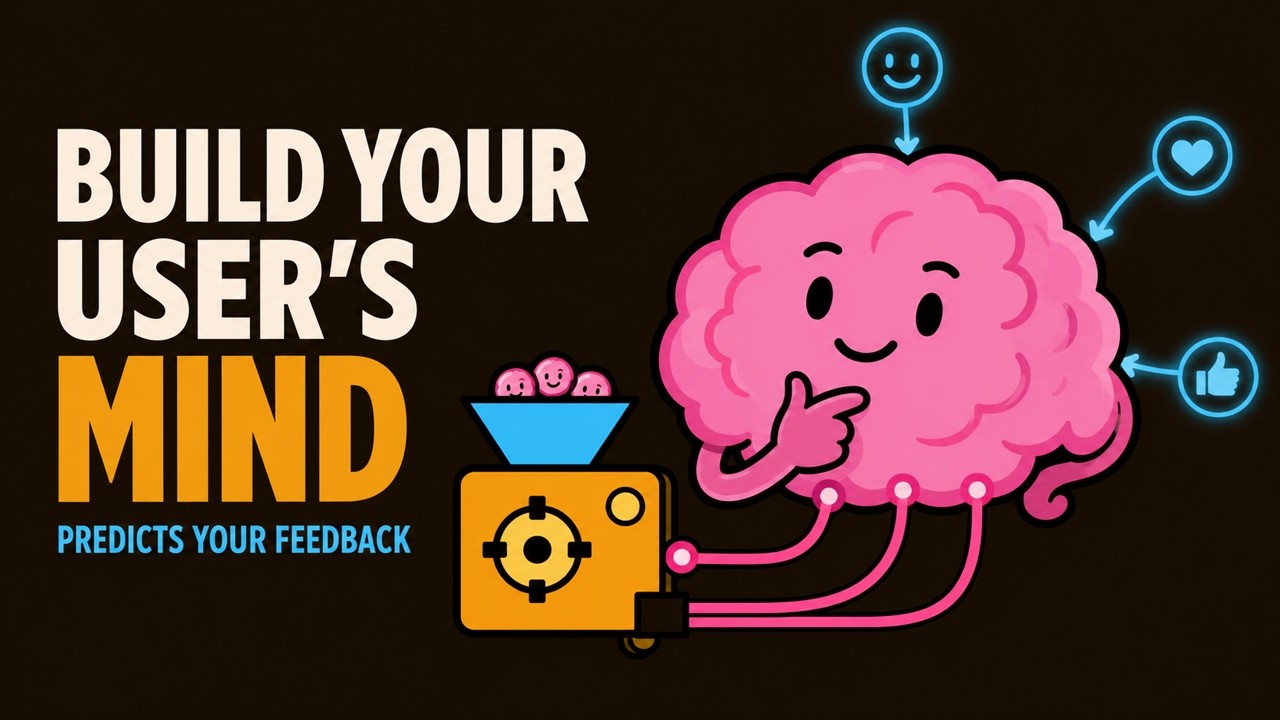
🎬 Watch the 2:28 demo: https://youtu.be/oJlrCHW-BXQ
- The Codex source adapter (
scripts/adapters/codex_adapter.py) — the component that reads Codex's own session logs — was written by Codex itself in Codex Session019ed298-fdc4-72d2-a255-97d7dc117128(commit1e3abc4, "Add Codex source adapter (delegated to Codex, control-tested)"), then control-tested on 946 real prompts. This earlier contribution is intentionally attributed to Codex without claiming a specific model version. - Codex also authored this repository's discovery metadata — commit
0ec49dfcarries the git authorCodex <codex@local>. It's all in the git history. - GPT-5.6 powered the final Build Week hardening pass through Codex (Codex Session
019f8674-fe9a-7d91-a80f-7ee799e8ced0). It found and fixed nine privacy and data-integrity defects across source extraction, redaction, corpus merging, and prediction scoring; the final deterministic suite contains 73 tests. - Codex is a first-class source: what Codex learns about the user flows into the same shared,
evidence-cited model that all agents consume (see
SOURCE-ADAPTERS.md).
| If you are... | Open first | Why |
|---|---|---|
| An AI agent adding user-memory discipline | SKILL.md |
End-to-end implementation recipe |
| A maintainer wiring log sources | SOURCE-ADAPTERS.md |
Claude, Codex, Gemini/agy and Kimi log locations |
| A reviewer checking safety boundaries | SECURITY.md and .gitignore |
Redaction, private-corpus and generated-avatar exclusions |
| A researcher comparing concepts | TAXONOMY.md |
Prompt-Archaeology categories and decision patterns |
Canonical search phrase: ellmos-ai/build-your-users-mind.
Useful discovery phrases:
AI agent theory of mind user modelLLM user modeling from interaction logsCodex Claude Gemini Kimi source adaptersprompt archaeology feedback precognitionlocal-first AI personalization templatesagent memory decision support from prompt logs
Disambiguation: this is not a SaaS personalization product, HR platform, chatbot persona pack, general prompt library or psychological diagnosis tool. It is a local-first documentation and script kit for building an evidence-backed user model from private agent interaction logs.
A 0→4 runtime loop (see templates/START.md):
| Step | File | Role |
|---|---|---|
| 0 | project DECISIONS.md |
project-specific decisions win (more specific) |
| 1 | WHAT-<USER>-SAID |
evidence-based rules/decisions (with prompt-ID citations) |
| 2 | WHAT-WOULD-<USER>-SAY |
precognition — predicted feedback + confidence (🟢/🟡/🔴) |
| 3 | WHAT-I-DID… + MY-ACTIONS.txt |
log of actions taken on the prediction |
| 4 | WHAT-<USER>-SAID-ABOUT… |
evaluation — prediction vs. reality → improves (1) and (2) |
Quality metric = how often the anticipated reaction matches the user's real later feedback.
At 🔴 (novel/no pattern) the rule is escalate, don't guess.
Measure it from the loop files with
scripts/score_predictions.py: hit rate overall and per
🟢/🟡/🔴 tier, plus the 🔴 escalation rate.
- Extract (
scripts/corpus_extract.py) — deterministic: pull only human-typed prompts from your logs, filter synthetic turns, redact secrets, link each prompt to the next turn'soutcome_signal(praise/correction/reissue/none). - Merge (
scripts/merge_corpora.py) — combine source-specific outputs without overwriting or renumbering stable evidence IDs. - Chunk (
scripts/chunk_corpus.py) — dedupe, optional domains, and build a fresh manifest bound to the exact corpus SHA-256. - Classify — use
templates/CLASSIFY-CHUNK.mdandschemas/classification.schema.json, then runscripts/validate_classifications.py. Missing rows, malformed output, stale files, and ID collisions are hard failures. - Aggregate (
scripts/aggregate_stats.py) — type distribution, B:K ratio, turning points. - Author the avatar files from
templates/and bind a short pointer into the agent's own memory/rules file (ClaudeCLAUDE.md, CodexGPT.md/AGENTS.md, GeminiGEMINI.md, …).
See SKILL.md for the full recipe and SOURCE-ADAPTERS.md for per-agent log locations.
The system models the dyad (agent ↔ user), not just the user in isolation — a theory of us. It is grounded in:
- Theory of Mind research for LLM agents — predicting and conditioning on an interlocutor's mental state improves outcomes (e.g. ToM-SWE, arXiv 2510.21903; Infusing Theory of Mind into Socially Intelligent LLM Agents, 2509.22887; Persistent Memory & User Profiles, 2510.07925).
- Prompt-Archaeology (L. Geiger) — the method of classifying full human-AI interaction protocols,
whose 8-type taxonomy this module reuses (
TAXONOMY.md). - A known limit: LLM ToM is robust on recurring cases, fragile under novel/adversarial variation — hence the confidence tiers and the "escalate, don't guess" rule.
- Silent approval is invisible — users type corrections, not praise → the model over-represents corrections and skews "critical". Calibrate accordingly.
- Evidence IDs are deterministic, but evidence claims and labels are synthesized — resolve load-bearing IDs against the raw corpus and review the inference.
- Classifier bias — spot-check a sample; report inter-rater agreement for serious use.
Use only logs the operator is authorized to process. Extractors fail closed on missing roots,
invalid dates, unreadable/empty inputs, and missing timestamps; an empty replacement requires
explicit --allow-empty, while accepting malformed partial input requires --allow-partial.
Writes are atomic and private where the platform supports permissions.
Built-in rules cover common current tokens (including modern project-scoped API tokens), credentials, asymmetric credential material,
emails, IP-like values, and long digit runs. Domain-specific health, legal, tax, financial, or other
sensitive content cannot be inferred reliably: provide reviewed --redaction-rules before writing
or sharing. Never commit a real corpus or filled avatar file — see .gitignore.
theory-of-mind · llm · user-modeling · personalization · ai-agents · prompt-analysis
· feedback · decision-support
Method: Prompt-Archaeology by Lukas Geiger. Module & concept: Lukas Geiger (+ Claude).
Bundled dependency: swarm-operations skill. MIT — see LICENSE.
Reference implementation (private, not shipped): a personal instance built on the author's own logs.