


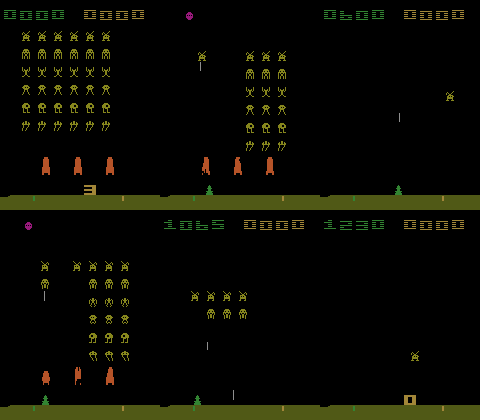
A PyTorch implementation of Deep Q-Learning Network (DQN) trained to play Atari Space Invaders using the Arcade Learning Environment (ALE).
- Vanilla DQN and Dueling DQN architectures.
- Double DQN support for improved stability.
- Replay Buffer for experience replay.
- Epsilon-greedy exploration with annealing (i.e., linear decay).
- TensorBoard integration for training visualisation.
- Hugging Face Hub integration for model sharing.
- Video recording of agent gameplay.
You can install the package from PyPI or clone the repository and install the required dependencies using Poetry or pip. This project requires Python 3.13.
pip install dqn-ale-spaceinvaders# 1. Clone the repository
git clone https://github.com/giansimone/dqn-ale-spaceinvaders.git
cd dqn-ale-spaceinvaders
# 2. Initialize environment and install dependencies
poetry env use python3.13
poetry install
# 3. Activate the virtual environment
eval $(poetry env activate)# 1. Clone the repository
git clone https://github.com/giansimone/dqn-ale-spaceinvaders.git
cd dqn-ale-spaceinvaders
# 2. Create and activate a virtual environment
python3.13 -m venv venv
source venv/bin/activate
# 3. Install package in editable mode
pip install -e .dqn-ale-spaceinvaders/
├── dqn_ale_spaceinvaders/
│ ├── agent.py # DQN agent implementation
│ ├── buffer.py # Experience replay buffer
│ ├── config.yaml # Agent configuration
│ ├── environment.py # Environment setup and wrappers
│ ├── model.py # Deep learning architectures
│ ├── train.py # Training script
│ ├── enjoy.py # Play with trained agent
│ ├── export.py # Export model to Hugging Face Hub
│ └── utils.py # Utility functions
├── .gitignore
├── LICENSE
├── README.md
└── pyproject.toml
Train a DQN agent with the default configuration.
python -m dqn_ale_spaceinvaders.trainThe training script will:
- Create a timestamped run directory in
runs/. - Save the configuration, checkpoints, and TensorBoard logs.
- Periodically evaluate the agent and save the best model.
Edit config.yaml to customize training parameters.
# Environment
env_id: ALE/SpaceInvaders-v5
frame_skip: 5
frame_stack: 4
resized_frame: 84

# Training
training_steps: 10000000
n_eval_episodes: 10

# Exploration
warmup_steps: 100000
epsilon_start: 1.0
epsilon_end: 0.1
anneal_steps: 1000000

# Replay Buffer
buffer_size: 200000
batch_size: 32

# Learning
gamma: 0.99
lr: 0.00025
update_every: 25000
target_update_every: 10000

# DQN Variants
double_dqn: False    # Enable Double DQN
dueling: False       # Enable Dueling DQN
clip_rewards: False # Clip rewards to [-1, 1]View training progress with TensorBoard:
tensorboard --logdir runs/dqn_YYYY-MM-DD_HHhMMmSSs/Watch your trained agent play:
python -m dqn_ale_spaceinvaders.enjoy --artifact runs/dqn_YYYY-MM-DD_HHhMMmSSs/final_model.pt --num-episodes 5Share your trained model:
python -m export \
    --username YOUR_HF_USERNAME \
    --repo-name dqn-spaceinvaders \
    --artifact-path runs/dqn_YYYY-MM-DD_HHhMMmSSs/final_model.pt \
    --movie-fps 12
This will:
- Create a repository on Hugging Face Hub.
- Upload the model weights, configuration, and evaluation results.
- Generate and upload a replay movie.
- Create a model card with usage instructions.
The network consists of:
- 3 convolutional layers for feature extraction.
- 2 fully connected layers for Q-value estimation.
- Input: 4 stacked 84×84 grayscale frames.
- Output: Q-values for each action.
Separates state value and action advantages:
- Shared convolutional backbone.
- Value stream: estimates state value V(s).
- Advantage stream: estimates action advantages A(s,a).
- Q(s,a) = V(s) + (A(s,a) - mean(A(s,a))).
- Warmup: Random exploration for initial experiences.
- Epsilon Annealing: Gradual reduction from exploration to exploitation.
- Experience Replay: Sample random mini-batches from replay buffer.
- Target Network: Separate network updated periodically for stability.
- Double DQN (optional): Reduces overestimation by decoupling action selection and evaluation.
This project is available under the MIT License.