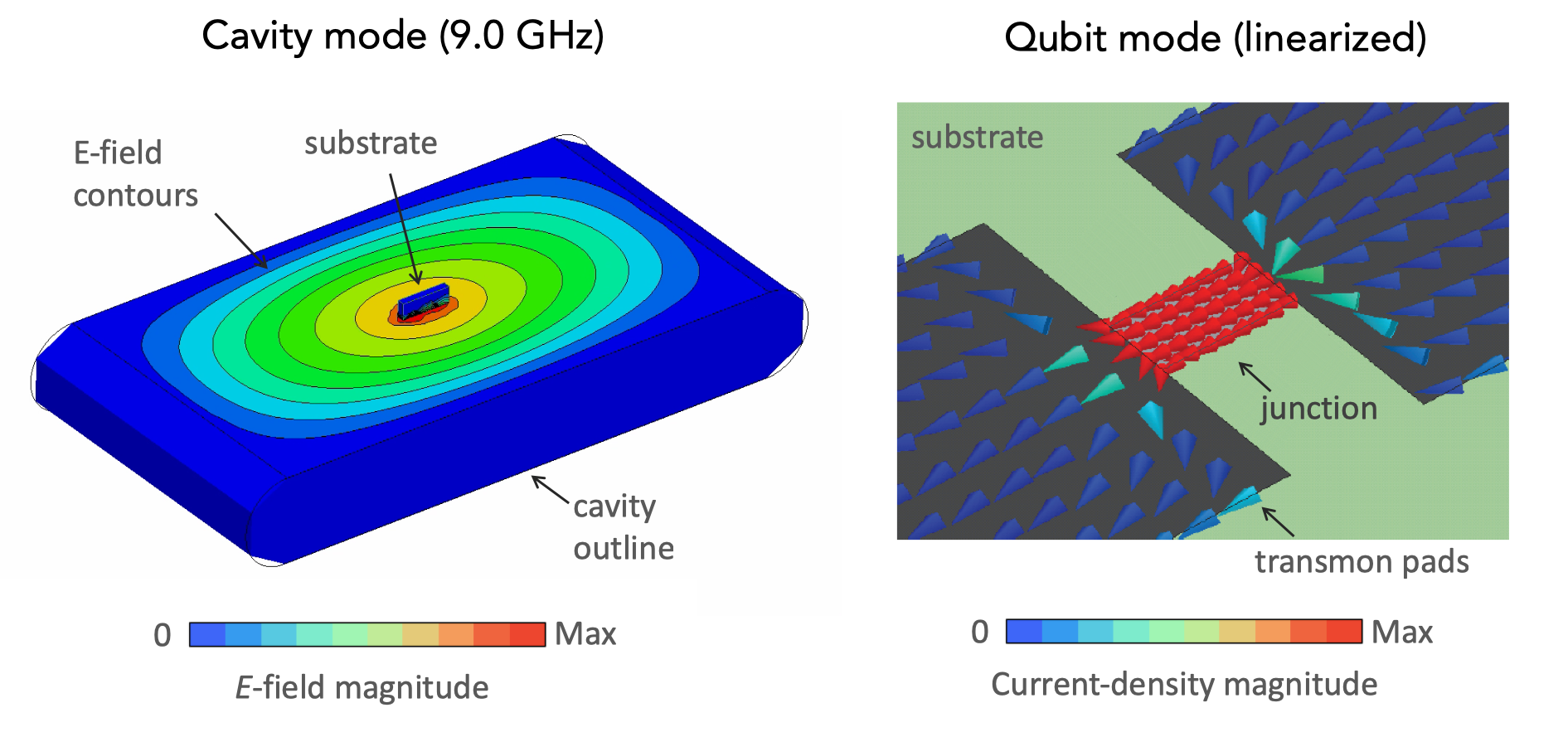
pyEPR bridges classical EM simulation and quantum circuit theory via the energy-participation ratio (EPR) method. Given a 3-D HFSS eigenmode simulation — or your own frequencies and inductances — it extracts the full quantum Hamiltonian in minutes:
- Simulate the linearized circuit in Ansys HFSS to get eigenmode frequencies and field distributions.
-
Extract energy participation ratios
$p_{mj}$ and zero-point phase fluctuations$\varphi_\mathrm{zpf}^{(mj)}$ for each junction and mode. -
Diagonalize
$H = \sum_m \omega_m a_m^\dagger a_m - \sum_j E_J[\cos\hat\varphi_j - 1 + \hat\varphi_j^2/2]$ numerically to get dressed frequencies, anharmonicities, and the dispersive-shift matrix$\chi$ .
Works for any number of modes and junctions.
Handles strongly anharmonic circuits (fluxonium,
No HFSS licence? The Hamiltonian diagonalization (steps 2–3) works with any frequencies and inductances. Start with Tutorial 6 on Binder — runs in your browser, no install.
pip install pyEPR-quantumRequires Python 3.9–3.12. All dependencies (numpy, qutip, matplotlib, …) are installed automatically.
conda:
conda install -c conda-forge pyepr-quantumdevelopment install:
git clone https://github.com/zlatko-minev/pyEPR.git && cd pyEPR
pip install -e ".[test]" && pytestCompute the transmon anharmonicity from first principles, no HFSS needed:
import numpy as np
from pyEPR.calcs.back_box_numeric import epr_numerical_diagonalization

# Standard transmon: E_J/h = 20 GHz, E_C/h = 300 MHz
# Plasma frequency f_p = sqrt(8 E_J E_C)/h ≈ 6.93 GHz
freqs   = np.array([6.928])     # GHz  (linearised plasma frequency)
Ljs     = np.array([8.2e-9])    # H    (Josephson inductance L_J = (Phi_0/2pi)^2 / E_J)
phi_zpf = np.array([[0.416]])   # dimensionless  (n_modes x n_junctions)

# Diagonalize — returns dressed frequencies in Hz and chi matrix in MHz
f_dressed, chi_matrix = epr_numerical_diagonalization(
    freqs, Ljs, phi_zpf, cos_trunc=8, fock_trunc=15
)
print(f"Qubit frequency : {f_dressed[0].real / 1e9:.3f} GHz")
print(f"Anharmonicity   : {chi_matrix[0,0].real:.0f} MHz")
# -> Qubit frequency : 6.615 GHz
# -> Anharmonicity   : 335 MHz
For multi-mode systems, fluxonium, or custom potentials: Tutorial 6.
import pyEPR as epr

# 1. Connect to Ansys HFSS
pinfo = epr.ProjectInfo(project_path=r'C:\sim_folder',
                        project_name=r'cavity_with_two_qubits',
                        design_name=r'Alice_Bob')

# 2. Specify Josephson junctions
pinfo.junctions['jAlice'] = {'Lj_variable':'Lj_alice', 'rect':'rect_alice',
                              'line': 'line_alice', 'Cj_variable':'Cj_alice'}
pinfo.junctions['jBob']   = {'Lj_variable':'Lj_bob',   'rect':'rect_bob',
                              'line': 'line_bob',   'Cj_variable':'Cj_bob'}
pinfo.validate_junction_info()

# 3. Extract EPR participation ratios
eprd = epr.DistributedAnalysis(pinfo)
eprd.do_EPR_analysis()

# 4. Quantum Hamiltonian — dressed frequencies and chi matrix
epra = epr.QuantumAnalysis(eprd.data_filename)
epra.analyze_all_variations(cos_trunc=8, fock_trunc=15)
epra.plot_hamiltonian_results(swp_variable='Lj_alice')Full docs, API reference, and guides: pyepr-docs.readthedocs.io
The tutorials are Jupyter notebooks in _tutorial_notebooks/.
| # | Title | HFSS? | Topics |
|---|---|---|---|
| 1 | Startup example | Yes | End-to-end workflow: HFSS → EPR → χ matrix |
| 2 | Dielectric loss EPR | Yes | Dielectric energy participation, loss rates, HFSS fields calculator |
| 3 | Circuit QED parameters | No | E_J, E_C, L_J, I_c conversions; transmon model |
| 4 | Parametric sweeps | Yes | HFSS Optimetrics: linear, log, file-based sweeps |
| 5 | Generic junction potential & fluxonium | No | Exact cosine for fluxonium; custom V(phi); asymmetric SQUIDs |
| 6 | EPR without HFSS | No | Numerical workflow: supply freqs, Ljs, phi_zpf directly |
Tutorials 3, 5, and 6 require only
pip install pyEPR-quantum— no Ansys licence.


pyEPR is used by superconducting qubit research groups worldwide, including:
- Yale University — Michel Devoret QLab and Rob Schoelkopf RSL
- IBM Quantum and Qiskit Metal
- QUANTIC — INRIA/ENS/MINES Paris/UPMC/CNRS (Zaki Leghtas group), France
- Quantum Circuit Group — Benjamin Huard, ENS Lyon, France
- Emanuel Flurin, CEA Saclay, France
- Ioan Pop group, KIT Physikalisches Institut, Germany
- UC Berkeley, Quantum Nanoelectronics Laboratory, Irfan Siddiqi
- Quantum Circuits, Inc. · Seeqc · Alice&Bob, France · Bleximo
- Serge Rosenblum Lab, Weizmann Institute, Israel
- University of Oxford — Leek Lab
- Britton Plourde Lab, Syracuse University
- Javad Shabani Lab, NYU
- UChicago Dave Schuster Lab · Lawrence Berkeley National Lab · Colorado School of Mines
- IPQC, SJTU, Shanghai · Bhabha Atomic Research Centre, India
- Quantum Device Lab ETHZ — Andreas Wallraff · Centre for Quantum Technologies / Qcrew
- SQC lab — Shay Hacohen-Gourgy, Israel · Quantum Computing UK
- ... and many more — e-mail
zlatko.minev@aya.yale.eduto be added.
| Feature | Windows | macOS | Linux |
|---|---|---|---|
| EPR / quantum analysis | Yes | Yes | Yes |
| Ansys HFSS COM interface | Yes | limited | limited |
The HFSS COM interface uses pythoncom/win32com (Windows). On macOS/Linux you can connect to a remote Windows HFSS instance via network COM.
PyAEDT is Ansys's official cross-platform AEDT scripting library. pyEPR and PyAEDT are complementary — use PyAEDT for geometry/mesh/solve automation, pyEPR for EPR quantization.
The EPR method requires each Josephson junction to be modelled as a lumped RLC boundary on a rectangle in HFSS, together with a polyline defining the current direction. Steps:
- Create a rectangle for each junction (e.g.,
rect_alice). Assign aLumped RLCboundary with inductance variableLj_alice. - Draw a polyline spanning the junction rectangle to define current flow (e.g.,
line_alice). - The linearised Josephson inductance used in HFSS is
$L_J = (\Phi_0/2\pi)^2/E_J$ . The full cosine potential is restored in the quantum Hamiltonian step. - Enable Save Fields for each variation if running parametric sweeps (Tutorial 4).
- Use
Mixed Ordersolutions for best accuracy.
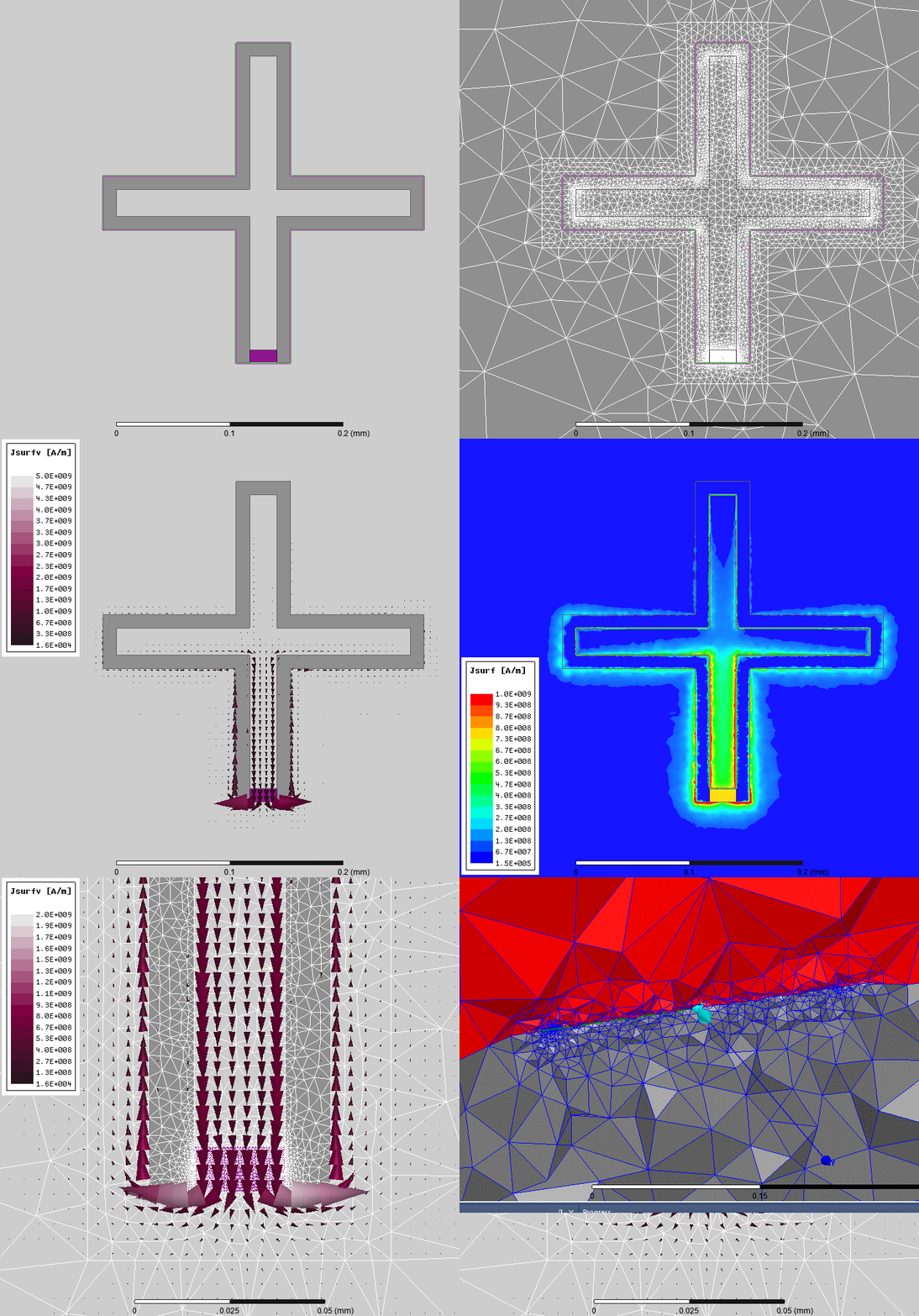
For a full walkthrough, see Tutorial 1 and the HFSS setup guide in the docs.
See the troubleshooting guide in the docs.
Common issues:
- pint error
system='mks' unknown— upgrade pint:pip install pint --upgrade - QuTiP not found — it is installed automatically with pyEPR-quantum; for manual install:
pip install qutip - COM Error on opening HFSS — check file path (no apostrophes/special chars); check HFSS hasn't popped an error dialog
- Parametric sweep missing field solutions — enable "Save Fields and Mesh" in ParametricSetup → Properties → Options (see Tutorial 4)
ValueError: cannot set WRITEABLE flag— upgrade numpy
If you use pyEPR in your research, please cite:
EPR method (primary reference):
Z. K. Minev, Z. Leghtas, S. O. Mundhada, L. Christakis, I. M. Pop, M. H. Devoret, Energy-participation quantization of Josephson circuits, npj Quantum Information 7, 131 (2021) · arXiv:2010.00620
Software (Zenodo DOI for the specific version):
BibTeX for both: pyEPR.bib
Related:
- Z. K. Minev, Ph.D. Dissertation, Yale (2018), Ch. 4 — arXiv:1902.10355
- A. Petrescu, C. T. Hann, Z. K. Minev et al., EPR for very anharmonic circuits — arXiv:2411.15039
- Authors: Zlatko Minev & Zaki Leghtas, 2015–present.
- Contributors: Phil Reinhold, Lysander Christakis, Devin Cody, Zachary Parrott, Asaf Diringer, and many others.
- Original
pyHFSS.pyandpyNumericalDiagonalization.pyby Phil Reinhold — original repo. - To contribute: open a GitHub issue or PR, or contact Z. Minev.