
A quiet research loop for the ideas hidden inside your workday.


Digital Unconscious turns the weak signals around your screen activity into a short daily briefing and a searchable idea backlog. Its Research Idea Lab can also turn your papers and the structure of a local dataset into cited evidence, research opportunities, and falsifiable study cards.
It is deliberately small. There is no cloud account, team workspace, social feed, or chat shell. Your signed-in Codex or Claude Code subscription can run the complete loop, so an API key is optional.
git clone https://github.com/shoal-rat/digital-unconscious.git
cd digital-unconscious
python -m pip install -e ".[vision,papers]"

du doctor
du daily --log-file tests/fixtures/daily_log.txt
du dashboard
du doctor reports which local subscription CLIs and optional providers are ready without printing secrets. If either Codex or Claude Code is installed and signed in, the app can run without an API key.
Install the richer desktop and research extras only if you need them:
python -m pip install -e ".[full]"
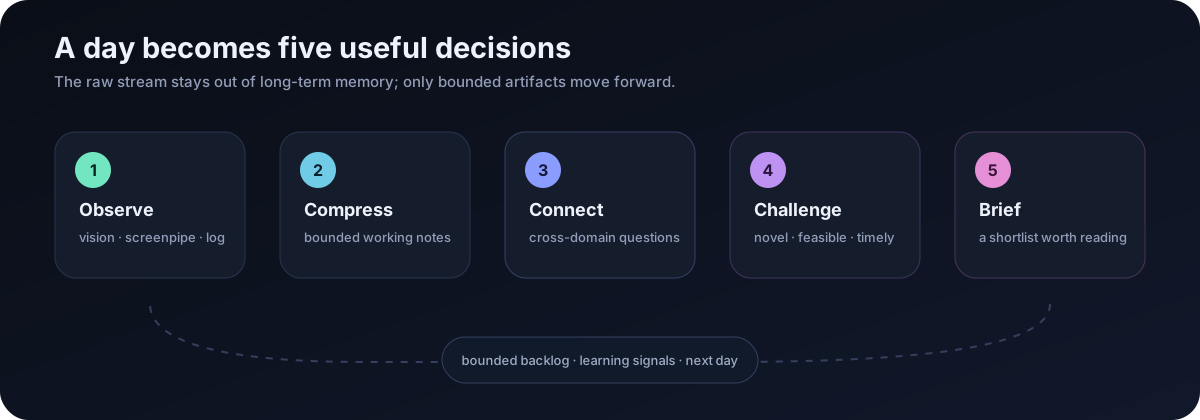
- Observe a screenshot, screenpipe stream, or plain text activity log.
- Compress noisy activity into bounded 30-minute working notes.
- Connect distant topics into concrete research questions.
- Challenge each idea for novelty, feasibility, fit, and timing.
- Brief only the strongest ideas and keep the rest in a bounded backlog.
- Research selected ideas through literature, feasibility, data, analysis, drafting, and review.
Every research stage writes JSON, readable Markdown, and trace events. Runs can be inspected and resumed without replaying completed work.
A daily scan does not start literature downloads, browser automation, or manuscript drafting by default. Exploration is an explicit action.
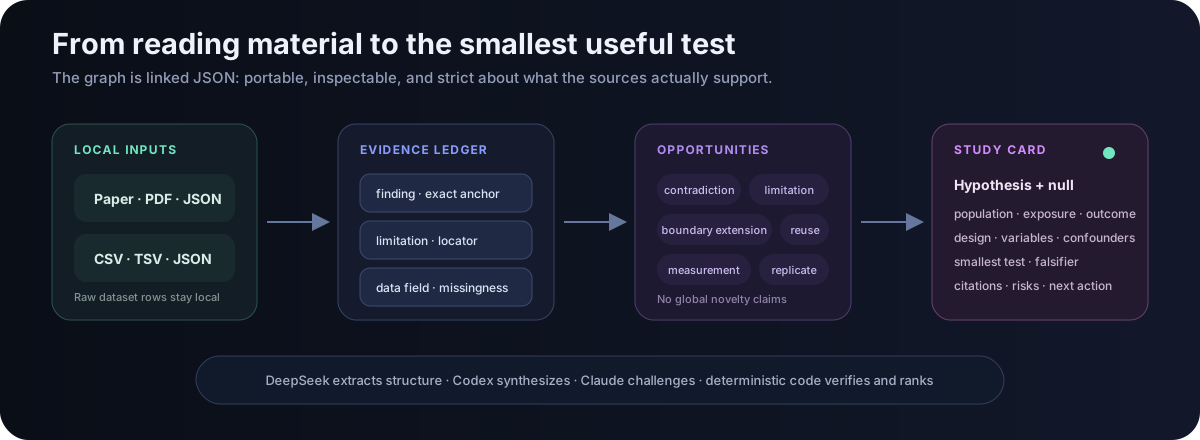
du ideate \
  --paper reading/paper.pdf \
  --paper workspace/runs/example/01_literature/papers.json \
  --data data/observations.csv \
  --context "One-month behavioral economics project; observational methods only"
Idea Lab verifies exact source anchors, profiles dataset structure without sending raw rows, detects named opportunity patterns, and rejects cards without a hypothesis, null, design, smallest useful test, falsifier, and valid evidence IDs. It writes a readable report plus linked JSON under workspace/ideation/session_*.
Novelty is deliberately reported as uncertainty—not as “nobody has done this.” The supplied corpus cannot establish that claim. Read the Idea Lab contract for input formats, scoring, privacy, and artifacts.
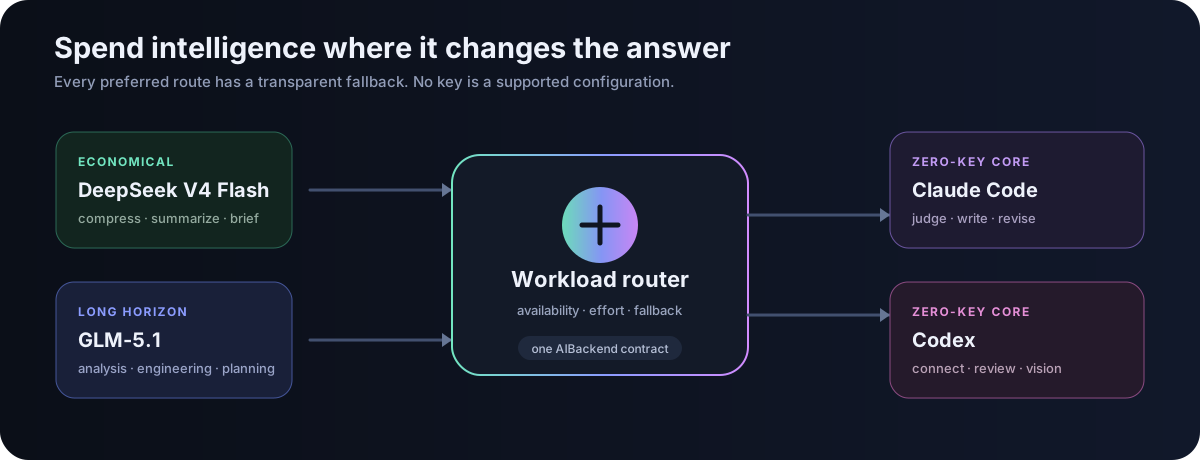
The default policy is opinionated but replaceable:
| Work | Preferred route | Why |
|---|---|---|
| Compression and briefing | DeepSeek V4 Flash, then local CLIs | Economical high-volume synthesis |
| Paper evidence extraction | DeepSeek V4 Flash, then local CLIs | Bounded structured extraction |
| Cross-source study design | Codex subscription | Strong linked reasoning with no API key |
| Adversarial methods review | Claude Code subscription | Careful challenge with no API key |
| Idea generation and adversarial review | Codex subscription | Strong structured reasoning with no API key |
| Judging, drafting, and revision | Claude Code subscription | Careful long-form work with no API key |
| Long-horizon analysis | GLM-5.1, then local CLIs | Optional agentic engineering path |
Missing credentials are normal. The router skips unavailable providers and falls through to Codex, Claude Code, or another configured backend. Inspect the effective plan with:
du modelsOptional hosted providers use environment variables:
export DEEPSEEK_API_KEY="..."   # DeepSeek V4 Flash / Pro
export ZAI_API_KEY="..."        # GLM-5.1
export OPENAI_API_KEY="..."     # GPT-5.6 family
export ANTHROPIC_API_KEY="..."  # Claude API
See Model routing for modes, prefixes, and fallback behavior.
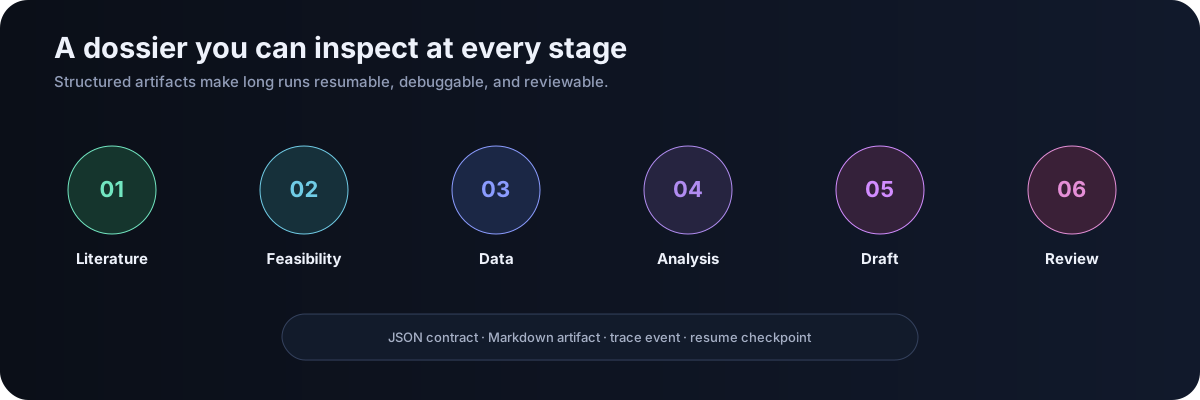
Promote a specific question or let the app choose the strongest backlog item:
du research --idea "How can sparse attention change long-running personal research agents?"
du research --auto
The pipeline searches open scholarly sources, checks feasibility, discovers datasets, creates analysis artifacts, drafts a dossier, and runs a review/revision loop. Final submission remains a human decision.
--resume --run-id … reloads completed artifacts instead of replaying their model or network work. Supplying a new --data-file preserves upstream discovery and rebuilds analysis plus downstream artifacts.
| Command | Purpose |
|---|---|
du doctor |
Check zero-key local runtimes and optional providers |
du daily [--log-file PATH] |
Run one observation-to-briefing cycle |
du dashboard |
Open the local dashboard |
du ideate --paper PATH [--data PATH] |
Build evidence-backed research study cards |
du explore … |
Alias for du ideate |
du models |
Explain per-agent routing and fallback |
du usage |
Summarize recorded token and cost metadata |
du research --idea "…" |
Start a six-stage research run |
du research --auto |
Promote the best backlog idea |
du learn |
Update the bounded personal idea model |
| `du service start | stop |
du config --focus "a,b" |
Narrow idea output to chosen fields |
The checked-in defaults live in config/pipeline.toml. The useful knobs are intentionally few:
[ai]
mode = "auto"
fallback = true
compressor_model = "deepseek:deepseek-v4-flash"
creative_model = "codex:default"
judge_model = "claude_code:sonnet"
evidence_model = "deepseek:deepseek-v4-flash"
ideation_model = "codex:default"
ideation_review_model = "claude_code:sonnet"

[observation]
source = "auto" # vision -> screenpipe -> file fallback
blacklist_apps = ["password manager", "bank"]

[idea]
focus_fields = ["economics", "management"]
include_threshold = 75
max_ideas_per_cycle = 8
auto_research_enabled = false
Provider prefixes are codex:, claude_code:, deepseek:, glm:, openai:, anthropic:, and kimi:.
“Local-first” here means storage, orchestration, retention, and the dashboard are local. It does not mean the selected language model runs on-device.
- Activity artifacts live under
workspace/and are ignored by Git. - Text summaries are sent to the selected model when a model-backed step runs.
- Vision sends the captured image to the selected model service, including when invoked through a subscription CLI.
- Temporary images used by Codex or Claude Code are isolated and deleted after each call.
- The setup page never stores API keys; optional hosted keys come from environment variables.
- An app blacklist can prevent capture from named applications.
- Browser automation never approves payments, CAPTCHA, MFA, or terms on your behalf.
- Idea Lab sends paper excerpts, but dataset inputs are reduced locally to schema and aggregate profile statistics; raw rows and example values stay local.
Read the complete security and data boundary before enabling passive vision.
The application keeps a stable AIBackend.call(...) contract while splitting implementation into four narrow pieces:
backends/base.py    response contract and shared normalization
backends/local.py   isolated Codex and Claude Code subscription runners
backends/hosted.py  optional API adapters
backends/router.py  availability, workload routing, and fallback
backlog.py          bounded identity and retention shared by every surface
ideation.py         source ledger, evidence graph, study cards, and ranking
The rest of the product remains provider-blind. See Architecture and the v2 reconstruction audit.
python -m unittest discover -s tests -v
python -m compileall -q src
python -m build
The core test suite does not require network access or provider credentials. Local Codex and Claude Code have separate smoke paths exposed through du doctor and the backend integration tests.
Digital Unconscious is for one person, on one machine, with bounded local memory. Multi-user deployment, institutional login automation, payments, and autonomous publication are intentionally outside the product.
MIT licensed. Contributions should preserve the small surface, honest privacy language, lazy optional dependencies, and human approval boundary described in AGENTS.md.